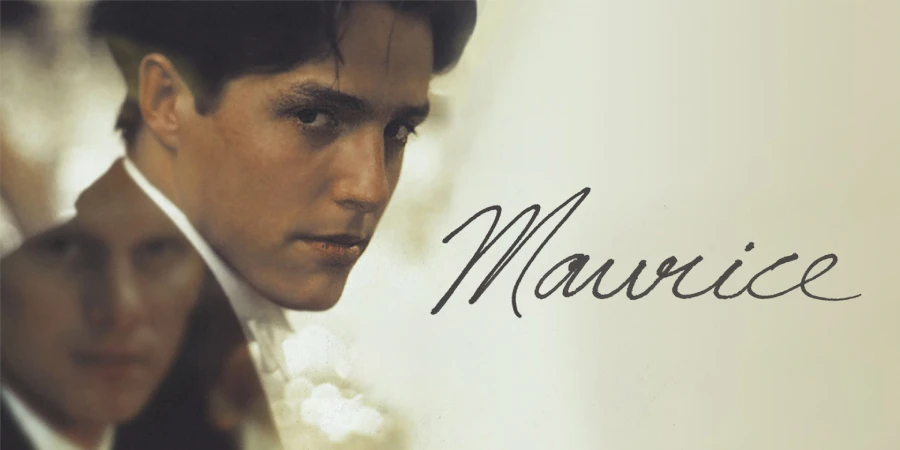

Maurice (1987), directed by James Ivory, is one of the most beloved Merchant-Ivory adaptations and remains a landmark film in LGBTQ+ cinema. Based on E. M. Forster’s posthumously published novel, it explores forbidden love, class divisions, and self-discovery in Edwardian England—handled with a tender, humane tone that still resonates today.
Detailed Summary
Maurice’s Early Years and Awakening
The film follows Maurice Hall (James Wilby), a young man growing up in rigid, upper-class Edwardian society. His early interactions with a schoolteacher about sex (a hilariously uncomfortable scene) foreshadow his emotional struggle. At Cambridge, he befriends Clive Durham (Hugh Grant), an idealistic, intellectual student. Their long philosophical conversations blossom into a confession: Clive tells Maurice he loves him. Maurice, confused yet deeply moved, reciprocates.
The Secret Romance at Cambridge
Their relationship is passionate but chaste—Clive insists on a platonic bond due to fear of societal consequences. These scenes, full of longing and restraint, define the emotional backbone of the film. Maurice’s feelings grow more physical, but Clive refuses to take that step. Their private intimacy contrasts with the rigidness of the time, making their love both beautiful and tragic.
Societal Pressure and Clive’s Fear
After Cambridge, Clive retreats further into respectability, political ambition, and social status. When a mutual acquaintance is arrested for homosexual acts, Clive panics. He abruptly ends the relationship, insisting their love was youthful fantasy. Maurice, devastated, slips into depression. This painful breakup is one of the film’s emotional peaks, portraying the cruelty of internalized fear and societal repression.
Maurice’s Struggle and Self-Discovery
Maurice tries to “cure” himself through hypnosis, highlighting the era’s pseudo-scientific cruelty toward homosexuality. His sessions fail, but they push him toward a crisis of identity. When he visits Clive at his estate (now married), he meets Alec Scudder (Rupert Graves), the gamekeeper. Alec observes Maurice with a sharp eye—curious, bold, and understanding in ways Maurice desperately needs.
Maurice and Alec
Alec and Maurice’s relationship begins with tension, then erupts into a spontaneous, passionate encounter—one of the most famous scenes in queer cinema. Their physical and emotional connection is immediate, genuine, and unapologetically real, contrasting sharply with Maurice’s tortured relationship with Clive.
However, Alec is of a lower social class, and the film does not shy away from the power imbalance. Still, their bond evolves into mutual trust, honesty, and—eventually—love.

Movie Ending
The ending of Maurice is considered revolutionary because it grants its gay protagonist a happy ending, something almost unheard of in LGBTQ+ stories of its era.
Alec, planning to emigrate to Argentina, asks Maurice to meet him before he leaves. Maurice believes Alec might be trying to blackmail him—a common fear in the period. But when he confronts Alec, he realizes the truth: Alec is in love with him.
Maurice must choose:
- a life of social acceptance, wealth, and repression like Clive, or
- a life of authenticity and love with Alec, even if it means scandal or exile.
In one of the film’s most emotional scenes, Maurice returns to Alec, embracing a future defined not by class or fear but by personal truth.
Their reunion in the boathouse is tender and decisive. Maurice chooses Alec. Alec chooses Maurice. They decide to run away and start a new life together.
The film ends with Clive, now trapped in a loveless marriage, standing at his estate’s window. Maurice is gone. Forever. Clive has the life he wanted—but not the love he lost. The contrast between Clive’s lonely respectability and Maurice’s brave leap into love is one of the most powerful finales in queer cinema.
Are There Post-Credits Scenes?
No. Maurice does not have mid-credits or post-credits scenes.
Type of Movie
Maurice is a romantic drama and period piece centered on forbidden love, self-acceptance, and social constraints in early 20th-century England.
Cast
- James Wilby as Maurice Hall
- Hugh Grant as Clive Durham
- Rupert Graves as Alec Scudder
- Denholm Elliott as Dr. Barry
- Simon Callow as Mr. Ducie
- Phoebe Nicholls as Anne Durham
Film Music and Composer
The film’s score was composed by Richard Robbins, known for his elegant, emotionally restrained music that perfectly fits Merchant-Ivory productions. His work here adds subtle melancholy, beauty, and tension without ever overpowering the story.


Filming Locations
Filming took place across England, including:
- King’s College, Cambridge – crucial for authenticity; the collegiate atmosphere shapes Maurice’s intellectual awakening.
- Wilbury House, Wiltshire – served as Pendersleigh, Clive’s estate. It establishes the class differences central to the story.
- Kent countryside – used for the scenes involving Alec, highlighting natural beauty and freedom, visually mirroring Maurice’s emotional liberation.
These real locations give the movie an authentic Edwardian feel while symbolically underscoring class divisions and personal transformation.
Awards and Nominations
- Won Best Actor (James Wilby & Hugh Grant jointly) at the Venice Film Festival
- Won Best Director (James Ivory) at Venice
- Also received awards for set design and costume design at several festivals
The film was praised particularly for performances, production design, and its groundbreaking portrayal of same-sex love.
Behind the Scenes Insights
- The film was shot before Hugh Grant became internationally famous; he initially feared the role could limit his career.
- E. M. Forster’s novel was published only after his death because he feared backlash.
- Rupert Graves was only 23 and relatively unknown; the role launched his career.
- The production insisted on filming in real period locations, despite the logistical headaches.
- James Ivory aimed for a fully authentic Edwardian aesthetic—even down to shaving styles and hand gestures.
Inspirations and References
The movie is adapted from E. M. Forster’s novel “Maurice”, inspired by his own experiences, secret relationships, and observations of repression in Edwardian society. The film remains largely faithful to his message of hope for queer people.
Alternate Endings and Deleted Scenes
- Some early cuts softened the final reunion between Maurice and Alec, but Merchant-Ivory insisted on retaining the strong, hopeful ending.
- A few longer Cambridge scenes were removed to streamline the pacing.
- Deleted material involving Alec’s family and village life was shot but never included.
No radically different alternate ending was filmed; the team felt strongly that the happy ending was essential.
Book Adaptations and Differences
The movie is highly faithful, but key differences include:
- The novel contains more of Maurice’s internal monologue and psychological conflict.
- Clive’s marriage and inner turmoil are explored more deeply in the book.
- Alec’s backstory is more detailed in the novel, emphasizing class contrast.
- The movie enhances the sensuality of Maurice and Alec’s relationship, which is more implied in the book.
Overall, the film preserves the book’s spirit while adapting it for visual storytelling.

Memorable Scenes and Quotes
Key Scenes
- Maurice and Clive confessing their love at Cambridge.
- Maurice’s devastating breakup with Clive.
- Maurice undergoing hypnosis in a desperate attempt to “change.”
- Maurice and Alec’s first intimate night—bold and deeply emotional.
- The final boathouse reunion that defines the film’s legacy.
Iconic Quotes
- “I am an unspeakable of the Oscar Wilde sort.” – Risley
- “I shall never be happy again.” – Maurice
- “I was yours, Alec.” – Maurice
- “You blindly say I must go back—back to what?” – Maurice
- “Maurice, don’t go.” – Alec
Easter Eggs and Hidden Details
- The film includes subtle references to real Edwardian trials involving homosexuality.
- Clive’s estate features paintings symbolizing repression and idealized love.
- Maurice’s clothing colors shift from muted tones to warmer shades as he discovers himself.
Trivia
- Merchant-Ivory filmed Maurice and Room With a View almost back-to-back.
- Many extras at Cambridge were real students.
- Rupert Graves had no formal acting training at the time.
- The film became a cult classic especially after the 1990s LGBTQ+ movement gained visibility.
Why Watch?
Maurice is essential for anyone interested in LGBTQ+ cinema, classic literature, or beautifully crafted period dramas. Its boldly hopeful ending, nuanced characters, and emotional honesty make it not just historically important but deeply moving. It’s a rare film that portrays same-sex love with dignity, complexity, and genuine warmth.
Director’s Other Movies
- A Room with a View (1985)
- Howards End (1992)
- The Remains of the Day (1993)
- Call Me by Your Name (2017) – producer
- The City of Your Final Destination (2009)
Recommended Films for Fans
- Call Me by Your Name (2017)
- Gods and Monsters (1998)
- Brokeback Mountain (2005)
- Another Country (1984)
- A Room with a View (1985)
- My Beautiful Laundrette (1985)