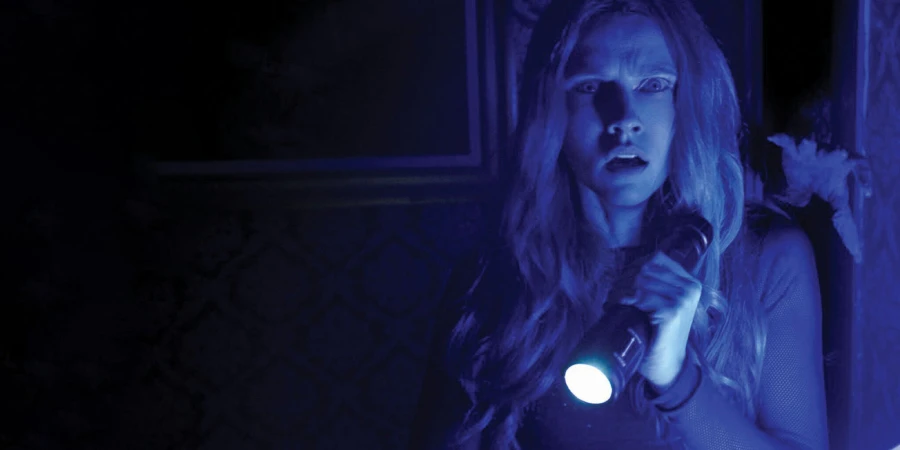
Lights Out (2016) is a compact, mean, and surprisingly emotional horror film that proves you don’t need an overstuffed runtime to deliver serious scares. Directed by David F. Sandberg and produced by James Wan, the movie takes a very simple fear — darkness — and turns it into a relentless supernatural threat.
Detailed Summary
The Opening: Fear Is Introduced Immediately
The film wastes no time. We open in a factory where a mysterious humanoid figure appears only when the lights go out. The owner is killed, and the message is crystal clear: if you can’t see it, it can kill you. This scene establishes the film’s core rule and never lets the audience forget it.
Rebecca Returns Home
Rebecca (Teresa Palmer) is a young woman who has distanced herself from her troubled mother Sophie. She left home years ago due to Sophie’s unstable behavior, choosing independence over chaos. However, her younger half-brother Martin still lives with Sophie and is experiencing disturbing nighttime events involving a shadowy figure named Diana.
Martin and the Rules of Darkness
Martin (Gabriel Bateman) quickly becomes the emotional anchor of the film. He understands the rules better than anyone:
- Diana only appears in darkness
- Light keeps her away
- Darkness means danger
His fear isn’t childish imagination — it’s survival instinct. The film smartly lets the child be the smartest character in the room.
Sophie’s Secret and Diana’s Origin
Rebecca discovers Sophie’s past in a psychiatric hospital, where Sophie befriended another patient: Diana. Diana had a rare skin condition that made her hypersensitive to light. Experimental treatments failed, ultimately killing her — but her hatred, pain, and attachment to Sophie survived.
Diana is not just a ghost. She is a parasitic presence, feeding off Sophie’s guilt and emotional dependence. Sophie’s refusal to let go is what keeps Diana alive.
The Final Confrontation Begins
As Diana grows stronger, she begins attacking anyone who threatens her bond with Sophie. Lights flicker, bulbs shatter, and safe spaces disappear. Rebecca realizes that the only way to stop Diana permanently is to break Sophie’s emotional tether to her.
This sets up the film’s moral dilemma: How far would a parent go to protect their child… and how far would a child go to save others from their parent?
Movie Ending
The final act takes place inside Sophie’s house, now almost completely overrun by darkness. Diana has become stronger than ever, physically attacking Rebecca and Martin. Artificial light barely holds her back anymore.
Rebecca finally understands the truth: Diana exists only because Sophie wants her to. Diana is a manifestation of Sophie’s mental illness, guilt, and need for companionship. As long as Sophie lives — and clings to Diana — Diana will never stop.
In the most devastating moment of the film, Sophie realizes this as well. Seeing her children injured and terrified because of her, she makes a final decision.
Sophie retrieves a gun and, standing in complete darkness, apologizes to Rebecca and Martin. She turns the weapon on herself and pulls the trigger.
The instant Sophie dies, Diana screams and disintegrates into nothingness. The darkness lifts. The house becomes safe. The curse is broken.
The film ends with Rebecca and Martin living peacefully. Rebecca has taken on a guardian role for her brother, and both appear emotionally stronger. However, the ending remains bittersweet — safety came at an unimaginable cost.
This conclusion is not a jump-scare ending. It is tragic, emotional, and final, making Lights Out stand out among modern horror films.
Are There Post-Credits Scenes?
No. Lights Out does not have a post-credits or mid-credits scene. Once the story ends, it stays ended — reinforcing the film’s bleak but definitive conclusion.
Type of Movie
Lights Out is a supernatural psychological horror film that blends ghost-story mechanics with themes of mental illness, trauma, and family responsibility. It focuses more on tension and atmosphere than gore.
Cast
- Teresa Palmer as Rebecca
- Gabriel Bateman as Martin
- Maria Bello as Sophie
- Alexander DiPersia as Bret
- Billy Burke as Paul
Film Music and Composer
The score was composed by Benjamin Wallfisch, whose minimalist, tension-heavy music relies on silence, low-frequency sounds, and sudden sonic spikes. The music is designed to heighten anxiety rather than guide emotion, which works perfectly with the film’s concept.

Filming Locations and Their Importance
The film was shot primarily in Los Angeles, California, using practical suburban homes and controlled interior sets.
The ordinary nature of these locations is essential. The horror works because it happens in familiar places: bedrooms, hallways, warehouses. The film constantly reminds the audience that darkness exists everywhere — not just in haunted mansions.
Awards and Nominations
- Nominated for Best Horror Film at several genre awards
- Praised by critics for Best Directorial Debut
- Widely recognized for effective low-budget horror design
While it didn’t dominate major award ceremonies, it became a critical and commercial success, especially for a first-time feature director.
Behind the Scenes Insights
- The film is based on David F. Sandberg’s 2013 short film of the same name.
- Sandberg directed the movie while battling severe anxiety, which influenced the film’s tone.
- Diana’s movements were performed practically and enhanced with minimal CGI.
- James Wan personally pushed to keep the film under 90 minutes to maintain intensity.
- The monster design avoided excessive detail to let the audience’s imagination do the work.
Inspirations and References
- David F. Sandberg’s original Lights Out short film
- Classic “darkness-based” horror concepts
- Psychological horror themes similar to The Babadook
- Real-world experiences with depression and emotional dependency
Alternate Endings and Deleted Scenes
An alternate ending was discussed where Sophie survives and receives treatment, weakening Diana instead of destroying her. This was ultimately rejected because it reduced the emotional weight and horror impact.
Several deleted scenes explored Sophie’s hospital past in more detail, but they were removed to keep pacing tight and suspense-focused.
Book Adaptations and Differences
Lights Out is not based on a book. It is adapted directly from a short film, which is nearly identical in concept but far less emotionally developed.
The feature film expands:
- Sophie’s mental illness
- The emotional bond between siblings
- The moral consequences of defeating the monster
Memorable Scenes and Quotes
Key Scenes
- The mannequin factory opening sequence
- Martin counting the seconds before his nightlight turns off
- Rebecca trapped in the warehouse with flickering lights
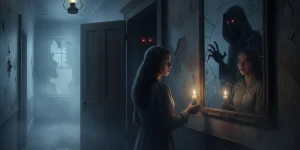
- Sophie’s final decision in complete darkness
Iconic Quotes
- “There’s something in the dark.”
- “You have to turn the lights on.”
- “She only comes when it’s dark.”
Easter Eggs and Hidden Details
- Diana’s silhouette matches the original short film exactly
- The factory logo in the opening scene appears again later in the film
- Diana never blinks — even in full light
- Her movement speed subtly increases as Sophie’s mental state worsens
Trivia
- The film was shot in under three months
- Diana has no visible eyes in total darkness
- The budget was under $5 million
- It grossed over $148 million worldwide
- David F. Sandberg later reused similar lighting techniques in Shazam!
Why Watch?
Because it delivers pure, efficient horror without wasting your time. It’s scary, emotional, and smart — proving that a simple idea, executed well, can outperform bigger-budget horror films.
If you’re afraid of the dark after watching this, congratulations — the movie did its job.