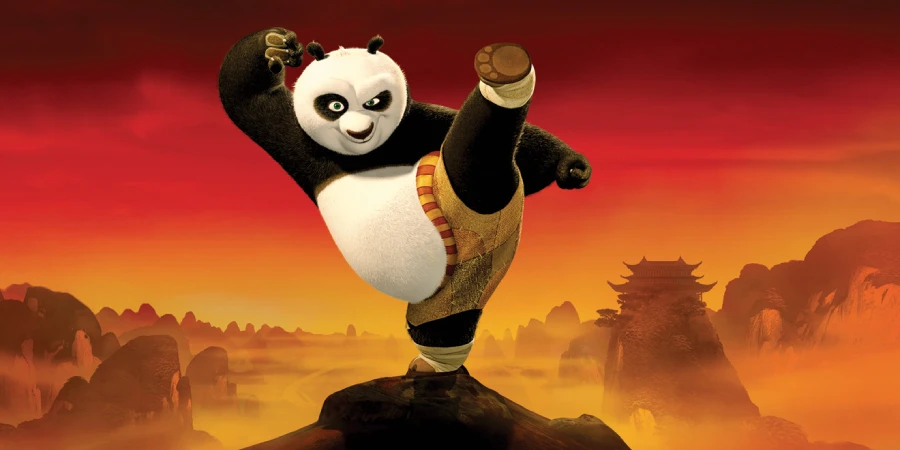

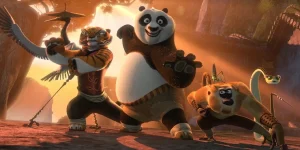
DreamWorks’ Kung Fu Panda (2008) is one of those animated films that looks like a simple comedy on the surface but manages to deliver heart, philosophy, and breathtaking martial arts action underneath.
Detailed Summary
Po’s Ordinary Life in the Valley of Peace
Po, a clumsy and food-loving panda, works in his dad’s noodle shop but dreams of being a kung fu master. He idolizes the Furious Five and spends his days imagining himself fighting alongside them. Even in this early stage, the film establishes the theme that greatness can come from unexpected places, a central message that the story continues to reinforce.
The Dragon Warrior Ceremony
When Master Oogway has a vision that the villain Tai Lung will escape prison, a ceremony is held to choose the prophesied Dragon Warrior. Po desperately wants to attend but ends up accidentally launched into the arena, where—much to everyone’s shock—Oogway points to him and declares him the Dragon Warrior. This moment sets the entire plot in motion and challenges the expectations of every character involved.
Tai Lung’s Escape and Rising Threat
On the other side of the story, Tai Lung—a snow leopard raised by Shifu—escapes from prison in an intense action sequence. The movie reveals the tragic backstory between Tai Lung, Shifu, and Oogway, making the antagonist’s motivations more layered than typical animated villains. His return represents Shifu’s greatest failure resurfacing.
Po’s Harsh Training
Shifu initially rejects Oogway’s choice and tries to train Po with the same strict methods used on the Furious Five. Naturally, this fails spectacularly. But Shifu soon discovers Po’s secret motivation: food. Using this, he trains Po in a way that finally works, showing the film’s message about individualized learning and true mentorship.
The Wuxi Finger Hold and the Final Confrontation Approaches
As Tai Lung approaches the Valley of Peace, Shifu gives Po the Dragon Scroll, only for them to discover it is blank except for a reflective surface. This becomes one of the film’s most important themes: there is no secret ingredient—believing in yourself is the path to greatness.
Movie Ending
Tai Lung reaches the Jade Palace and confronts Shifu in one of the film’s most emotional and intense scenes. Shifu apologizes for failing Tai Lung as a father figure, but the snow leopard is too consumed by anger to accept it.
Meanwhile, Po realizes the true meaning of the Dragon Scroll: there is no secret ingredient; special power comes from within. With his newfound confidence, Po rushes back and battles Tai Lung in the Valley of Peace. The fight blends humor with incredible kung fu choreography, making it one of the most memorable climaxes in animated cinema.
Po ultimately uses the legendary Wuxi Finger Hold—a technique Tai Lung mocked earlier—to defeat him, unleashing a powerful golden energy blast.
The Valley celebrates Po as the true Dragon Warrior. Shifu, who survives but is injured, finally finds peace. The ending fully resolves Po’s self-doubt, Shifu’s guilt, and the prophecy that started the story.
Are There Post-Credits Scenes?
No, Kung Fu Panda (2008) does not have a post-credits scene. Once the main story ends, the credits roll without hidden sequences or teasers.
Type of Movie
Kung Fu Panda is an animated action-comedy martial arts adventure film with heartfelt philosophical themes. It blends humor with powerful character growth and cinematic kung fu moments.
Cast
- Jack Black as Po
- Dustin Hoffman as Master Shifu
- Ian McShane as Tai Lung
- Angelina Jolie as Tigress
- Jackie Chan as Monkey
- Lucy Liu as Viper
- Seth Rogen as Mantis
- David Cross as Crane
- James Hong as Mr. Ping
- Randall Duk Kim as Master Oogway
Film Music and Composer
The score was composed by Hans Zimmer and John Powell. Together they created a musical blend of Chinese instrumentation and orchestral emotional beats. Some tracks, especially during training montages and Tai Lung’s escape, have become iconic in modern animation.
Filming Locations (Animation Production)
While animated films don’t have traditional shooting locations, Kung Fu Panda took heavy inspiration from:
- Chinese mountain temples
- Ancient martial arts schools
- Sichuan Province landscapes
These inspirations are evident in the Jade Palace, the Peach Tree of Heavenly Wisdom, and the tranquil Valley of Peace. They lend the movie an authentic yet stylized Eastern aesthetic.
Awards and Nominations
- Nominated for Academy Award for Best Animated Feature
- Nominated for Golden Globe Award for Best Animated Feature
- Won Annie Awards, including Best Animated Feature and Best Production Design
- Widely praised for animation, action choreography, and emotional depth
Behind the Scenes Insights
- Jack Black improvised many of Po’s comedic lines, shaping Po’s personality.
- Animators trained with real kung fu instructors to capture accurate movements.
- The film originally depicted Po as a more jokey slapstick character, but was rewritten to include deeper emotional layers.
- The production team visited China for artistic reference, sketching temples, forests, and ancient architecture.
Inspirations and References
- Inspired by Chinese kung fu films, especially classics by Jackie Chan and Jet Li.
- References to wuxia storytelling, including themes of destiny, inner strength, and mentorship.
- The peaceful Peach Tree setting is influenced by Chinese mythology and Buddhist imagery.
Alternate Endings and Deleted Scenes
No publicly revealed alternate endings exist, but several deleted scenes include:
- Extended training sequences
- A scene with Po bonding with Tigress, later removed for pacing
- Additional comedic moments in the noodle shop
Book Adaptations and Differences
Kung Fu Panda is not based on a book, but it inspired multiple books afterward such as novelizations and children’s storybooks. Since the movie is original, all stories and lore start from the film itself.
Memorable Scenes and Quotes
Key Scenes
- Po’s rocket-chair entrance into the Dragon Warrior ceremony
- Tai Lung’s high-adrenaline prison escape
- Shifu discovering Po’s food-based motivation
- The reflective revelation of the Dragon Scroll
- The final fight with the Wuxi Finger Hold
Iconic Quotes
- “There is no secret ingredient.”
- “You just need to believe.”
- “One often meets his destiny on the road he takes to avoid it.” – Oogway
- “I’m not a big fat panda. I’m the big fat panda.” – Po
Easter Eggs and Hidden Details
- Po’s training dummies reference classic Bruce Lee films.
- The Peach Tree of Heavenly Wisdom mirrors spiritual symbols associated with enlightenment.
- The Kung Fu move names used in training sequences are references to real techniques.
- Tigress’ stripes subtly form a frown, reflecting her disciplined personality.
Trivia
- Po was originally designed to be slimmer, but animators changed him to better fit his personality.
- Tai Lung’s escape scene took over a year for the animation team to complete.
- The movie inspired DreamWorks to create a full martial arts choreography team for future films.
- Oogway’s character was named after the Mandarin word for “tortoise.”
Why Watch?
Because Kung Fu Panda isn’t just an animated comedy—it’s a visually rich, emotionally layered, and brilliantly choreographed martial arts story. Its humor is universal, its action is surprisingly cinematic, and its message about self-worth is both timeless and powerful. It’s one of those films where kids laugh, adults reflect, and everyone leaves feeling inspired.
Directors’ Other Works
Directed by Mark Osborne and John Stevenson, whose notable works include:
- The Little Prince (2015)
- More (1998)
- Sherlock Gnomes (2018)
- Worked in art/animation roles on Shrek (2001) and Madagascar (2005)
Recommended Films for Fans
- Kung Fu Panda 2 (2011)
- Kung Fu Panda 3 (2016)
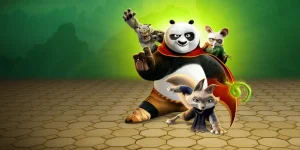
- Kung Fu Panda 4 (2024)
- How to Train Your Dragon (2010)
- Big Hero 6 (2014)
- Mulan (1998)
- Kubo and the Two Strings (2016)
- The Lego Ninjago Movie (2017)