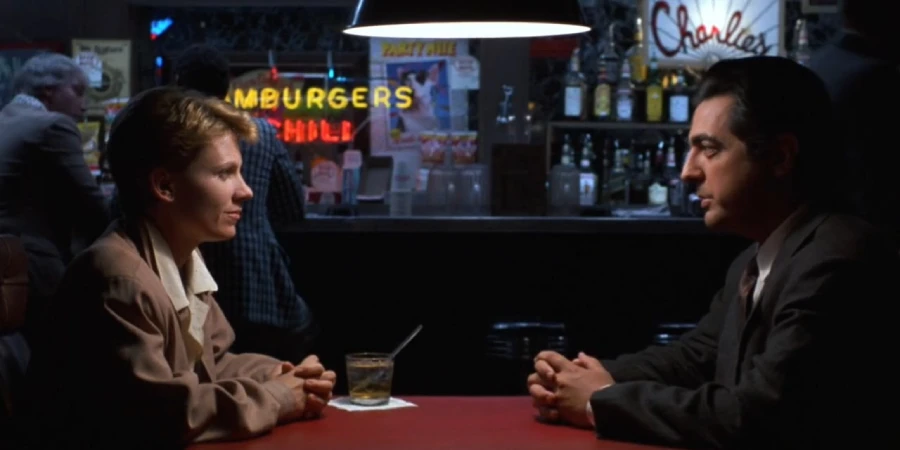
David Mamet’s directorial debut is not just a film about con artists; it is itself a masterfully constructed con on the audience. House of Games meticulously builds a world of deception where every word is a potential lie. Ultimately, the film poses a chilling question: who is the real predator, and who is the prey?
Detailed Summary
The Troubled Psychiatrist and the Compulsive Gambler
Dr. Margaret Ford is a successful psychiatrist and best-selling author of a book called Driven: Obsession and Compulsion. She seems to have her life completely under control. However, her professional curiosity is piqued when a patient, a gambler named Billy Hahn, threatens suicide over a massive debt owed to a man named Mike.
Intrigued and perhaps a bit arrogant, Margaret decides to intervene directly. She goes to the House of Games, a smoky backroom poker den, to confront Mike. This decision marks her first step into a world she only understands from textbooks.
A Calculated Game of Poker
She finds Mike Mancuso, a smooth-talking and charismatic con man. Instead of being intimidated, however, Mike draws her into his world. He reveals Billy’s debt is only $800, far less than the $25,000 Billy claimed.
Mike then allows Margaret to observe a high-stakes poker game. He claims to see a “tell” on another player and asks Margaret for $6,000 to win the pot, promising her a cut. Captivated by the thrill, she agrees, handing over the money for a game she believes is real.
The Briefcase and the Tell
Margaret quickly becomes entangled in another, larger con. Mike and his crew stage a scenario involving a briefcase full of money at a hotel. They need to trick a supposed “mark” into leaving his hotel room so they can retrieve it.
Margaret’s role is to act as a distraction. The entire setup, including a fake fight and a planted water pistol, is designed to test her nerve. Fascinated by the psychology of the scam, she plays her part perfectly, feeling a sense of power she has never experienced before.
The Hotel Room Seduction
The cons escalate. Later, Mike lures Margaret to a hotel room under the pretense of meeting the “big man” behind the operation. There, he spins a story about being in grave danger from other criminals.
This elaborate performance is the climax of their manipulation. As a result, Margaret, believing she is helping him escape, gives Mike all of her savings—$80,000. Their interaction is charged with a tense, almost romantic energy that clouds her judgment completely.
Unraveling the Deception
The illusion shatters the next day. Margaret sees Billy Hahn, the “suicidal” patient who started it all, setting up another con with members of Mike’s crew. She realizes with dawning horror that every single event was staged.
Billy was never her patient in crisis; he was the bait. The poker game, the briefcase, the danger—it was all an elaborate theater piece with her as the sole audience and, ultimately, the mark. Consequently, a cold fury begins to replace her intellectual curiosity.

Movie Ending
Margaret Ford tracks Mike to the airport, where he and his crew are preparing to leave town. She confronts him not with tears or pleas, but with a chilling composure. Mike, ever the con artist, tries to talk his way out of it, admitting to the long con and even complimenting her resilience.
He taunts her, claiming she came back because she has nowhere else to go and secretly enjoyed being part of their world. In a shocking turn, Margaret asks him to beg for his life, a request he smugly refuses. She then retrieves a gun from her purse and shoots him multiple times, killing him in a deserted airport lounge.
In the final scene, we see Margaret having lunch with a colleague sometime later. She nonchalantly steals a gold lighter from the table, a sly smile playing on her lips. She has not been destroyed by the experience; instead, she has fully absorbed its lessons, transforming from a clinical observer of compulsion into a cold, practicing sociopath.
Are There Post-Credits Scenes?
No, House of Games has no post-credits scenes. Once the credits begin, the film is officially over.
Type of Movie
House of Games is a quintessential neo-noir psychological thriller. Its tone is cerebral, tense, and clinical, reflecting the protagonist’s initially detached worldview. Director David Mamet’s signature clipped, rhythmic dialogue creates a stylized and claustrophobic atmosphere where language itself is a weapon.
Cast
- Lindsay Crouse – Dr. Margaret Ford
- Joe Mantegna – Mike Mancuso
- Mike Nussbaum – Joey
- Lilia Skala – Dr. Maria Littauer
- J. T. Walsh – The Businessman / “Cop”
- Ricky Jay – George / “Vegas Man”
- William H. Macy – Sgt. Moran
Film Music and Composer
The score for House of Games was composed by Alaric Jans, a frequent collaborator on David Mamet’s stage productions. His music is minimalist and understated. It relies heavily on a simple, moody piano theme and subtle jazz inflections.
This sparse score effectively heightens the film’s psychological tension. Notably, it avoids overt emotional cues, forcing the audience to focus on the intricate dialogue and the characters’ ambiguous motivations.



Filming Locations
House of Games was primarily filmed on location in Seattle, Washington. Mamet chose the city for its perpetually overcast skies and rain-slicked streets. These elements create a perfect backdrop for the film’s neo-noir aesthetic.
Its dark, atmospheric look contributes significantly to the feeling of moral ambiguity and hidden danger. The locations feel authentic, from the shadowy bars to the anonymous hotel rooms where the cons unfold.
Awards and Nominations
While not a major Academy Award contender, House of Games received significant critical acclaim. David Mamet’s screenplay won Best Screenplay at the 1987 Venice Film Festival. It also earned a Golden Globe nomination for Best Screenplay.
Behind the Scenes Insights
- This was the directorial debut of celebrated playwright David Mamet, who also wrote the screenplay.
- Lead actress Lindsay Crouse was married to David Mamet at the time of filming.
- Ricky Jay, who played George, was a world-renowned magician and expert on confidence scams and sleight of hand. He also served as a consultant on the film to ensure the scams appeared authentic.
- Many of the supporting actors, including Joe Mantegna, William H. Macy, and Mike Nussbaum, were longtime members of Mamet’s theater company in Chicago.
Inspirations and References
The film is heavily inspired by the structure and themes of classic film noir from the 1940s and 1950s. It features many noir tropes, including a protagonist drawn into a criminal underworld, a charismatic but dangerous male lead, and a pervasive sense of moral decay.
Furthermore, Mamet drew inspiration from non-fiction books about con artists, particularly The Big Con by David Maurer. He wanted to explore the unique, coded language and psychological manipulation inherent in the world of the confidence game.
Alternate Endings and Deleted Scenes
There are no known alternate endings or officially released deleted scenes for House of Games. David Mamet is known for his tightly controlled scripts and precise vision, and the final cut of the film is widely considered to be his definitive version.
Book Adaptations and Differences
House of Games is not based on a book. It is an original screenplay written by David Mamet, born from his long-standing fascination with the art of the con and the psychology of deception.


Memorable Scenes and Quotes
Key Scenes
- The Poker Game: Margaret’s first immersion into the con, where Mike expertly explains the concept of a “tell” while simultaneously running a scam on her. Her academic fascination visibly transforms into active participation.
- The Western Union “Sting”: The scene where Margaret must confront a confederate posing as a cop. Her ability to lie convincingly under pressure marks a significant turning point for her character.
- The Airport Confrontation: The film’s chilling climax, where Margaret calmly and methodically murders Mike, demonstrating her complete transformation from victim to predator.
Iconic Quotes
- “It’s called a confidence game. Why? Because you give me your confidence? No. Because I give you mine.” – Mike Mancuso
- “When you’ve been my patient for a year, you’ll be happy to be alive.” – Dr. Margaret Ford
- “Don’t you want to beg for your life?” – Dr. Margaret Ford
- “Human nature, my friend. Human nature.” – Mike Mancuso
Easter Eggs and Hidden Details
- Authentic Sleight of Hand: In the poker scenes, expert magician Ricky Jay performs genuine card manipulations, adding a layer of authenticity to the cons depicted.
- The Lighter: The gold lighter Margaret steals in the final scene is visually similar to one Mike used earlier. This subtly suggests she has not just adopted his mindset but also his mannerisms.
- Mamet’s Dialogue: The film’s famously stylized, staccato dialogue, known as “Mamet-speak,” is itself a hidden detail. It creates an artificial, theatrical world where nothing feels quite real, mirroring the nature of a con.
Trivia
- The voice of the announcer on the airport PA system during the film’s climax is David Mamet.
- Joe Mantegna won the Best Actor award at the Venice Film Festival for his performance as Mike Mancuso.
- The book Margaret Ford authored, Driven, has a cover that was deliberately designed to mimic the style of popular psychology books from the 1980s.
Why Watch?
Watch House of Games for its razor-sharp dialogue and a plot that coils like a serpent. This film is a brilliant psychological puzzle box. Its masterful script and chilling performances will keep you guessing until the final, shocking moments.
Director’s Other Movies
- Homicide (1991)
- The Spanish Prisoner (1997)
- Heist (2001)
- Spartan (2004)
- Redbelt (2008)
Recommended Films for Fans
- The Grifters (1990)
- Body Heat (1981)
- Glengarry Glen Ross (1992)
- Matchstick Men (2003)
- The Usual Suspects (1995)