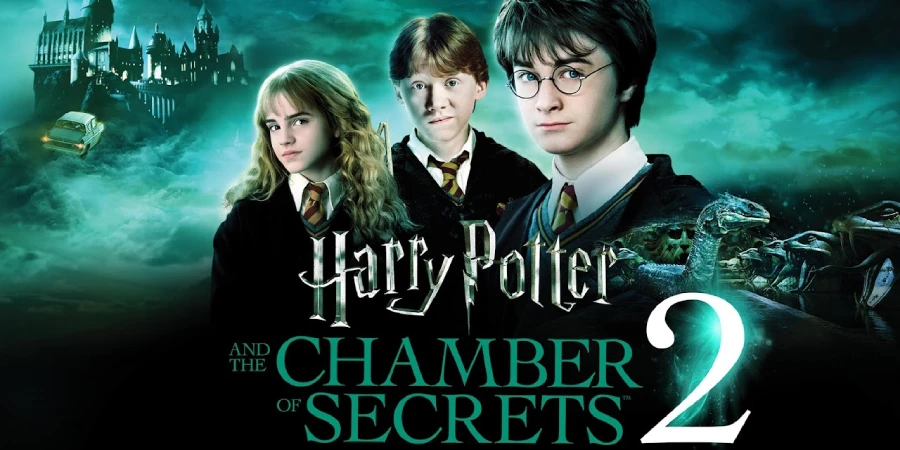

Harry Potter and the Chamber of Secrets (2002) is the second installment in the Harry Potter film series and continues the magical journey with darker themes, higher stakes, and a stronger sense of mystery. Directed by Chris Columbus, the film expands the wizarding world while deepening character relationships and introducing long-lasting lore elements.
Detailed Summary
A Dark Warning at Privet Drive
The film begins with Harry Potter spending another miserable summer with the Dursleys. His birthday is ignored once again, until Dobby the house-elf appears in his bedroom. Dobby warns Harry not to return to Hogwarts, claiming that terrible danger awaits him there. When Harry refuses, Dobby sabotages a dinner party, resulting in Harry being magically confined to his room by the Ministry of Magic.
The Flying Car and Return to Hogwarts
Harry is rescued by Ron, Fred, and George Weasley in a flying Ford Anglia. After missing the Hogwarts Express, Harry and Ron fly the car to school, crashing into the Whomping Willow, earning punishment but also marking one of the film’s most memorable moments.
The Chamber is Opened
Soon after the school year begins, eerie messages appear on Hogwarts walls announcing that the Chamber of Secrets has been opened. Students begin turning into stone, and fear spreads through the school. Harry starts hearing strange voices that no one else can hear, which raises suspicion around him.
The Heir of Slytherin and the Mystery Deepens
The legend of the Chamber claims it was created by Salazar Slytherin, and that only his heir can open it to unleash a monster that will purge Hogwarts of Muggle-born students. Harry discovers unsettling connections between himself and Slytherin, including the ability to speak Parseltongue, the language of snakes.
Tom Riddle and the Diary
Harry finds a mysterious diary belonging to Tom Riddle, a former Hogwarts student. Through magical flashbacks, Harry learns about events from 50 years earlier and sees Hagrid being blamed for opening the Chamber. Meanwhile, Hermione is petrified, but not before leaving a crucial clue.
Ginny Weasley Disappears
The crisis reaches its peak when Ginny Weasley is taken into the Chamber. With Hogwarts on the brink of closure, Harry and Ron follow the trail into the Chamber itself, uncovering the truth behind the monster and the diary.
Movie Ending
Harry enters the Chamber of Secrets and discovers that Ginny Weasley has been possessed by Tom Riddle, who is revealed to be a memory preserved in the diary. Riddle explains that he used Ginny to reopen the Chamber and that he is, in fact, Lord Voldemort’s younger self.
The monster of the Chamber is revealed to be a giant Basilisk, which attacks Harry. With the help of Fawkes the phoenix, Harry obtains the Sorting Hat, from which Godric Gryffindor’s sword emerges. Harry kills the Basilisk but is mortally wounded by its venom.
Fawkes heals Harry with phoenix tears. Harry then destroys Riddle’s diary by stabbing it with a Basilisk fang, eliminating the magical fragment of Voldemort’s soul and freeing Ginny from possession.
Back at Hogwarts, Dumbledore exposes Lucius Malfoy as the one who slipped the diary to Ginny. Harry tricks Lucius into freeing Dobby by giving him a sock hidden inside Riddle’s diary. The film ends with Hagrid returning, Hermione being cured, and Hogwarts restored to peace, while hinting that Voldemort’s return is far from over.
Are There Post-Credits Scenes?
No, Harry Potter and the Chamber of Secrets does not include any post-credits or mid-credits scenes. The story fully concludes before the credits roll.
Type of Movie
The film is a fantasy adventure with strong mystery and coming-of-age elements. Compared to the first movie, it leans more heavily into darker themes and suspense while still maintaining a family-friendly tone.
Cast
- Daniel Radcliffe as Harry Potter
- Rupert Grint as Ron Weasley
- Emma Watson as Hermione Granger
- Kenneth Branagh as Gilderoy Lockhart
- Jason Isaacs as Lucius Malfoy
- Bonnie Wright as Ginny Weasley
- Robbie Coltrane as Rubeus Hagrid
- Maggie Smith as Minerva McGonagall
- Richard Harris as Albus Dumbledore
Film Music and Composer
The score was composed by John Williams, continuing the iconic musical themes established in the first film. New motifs were introduced to reflect the darker tone, especially during scenes involving the Chamber and the Basilisk.
Filming Locations
- Leavesden Studios (England): Primary filming location and home to most Hogwarts interiors
- Durham Cathedral: Used for Hogwarts cloisters
- Glencoe (Scotland): Exterior landscape shots
- Christ Church College, Oxford: Inspiration for the Great Hall
These locations helped ground the magical world in real, historic architecture, enhancing immersion.
Awards and Nominations
- Nominated for BAFTA Best Production Design
- Nominated for Saturn Award for Best Fantasy Film
- Nominated for Visual Effects Society Awards
While it didn’t win major awards, the film was widely praised for its production quality and faithfulness to the source material.
Behind the Scenes Insights
- The Basilisk was entirely CGI and one of the most complex visual effects challenges at the time
- Kenneth Branagh improvised many of Gilderoy Lockhart’s flamboyant mannerisms
- The flying car scene required a full-scale mechanical replica for close-up shots
- Chris Columbus insisted on staying close to the book, making this the longest Harry Potter film
Inspirations and References
The movie is based on “Harry Potter and the Chamber of Secrets” (1998) by J.K. Rowling. Themes of prejudice, identity, and fear of the “other” are more pronounced here, reflecting classic mythological monster tales and school-based mystery novels.
Alternate Endings and Deleted Scenes
Several scenes were deleted for pacing, including extended classroom moments and additional dialogue involving Lockhart. No alternate ending was filmed; the final confrontation closely follows the novel.
Book Adaptation and Differences
The film is one of the most faithful adaptations in the series. Minor differences include shortened subplots and less emphasis on the school’s political tension, but major story beats and character arcs remain intact.

Memorable Scenes and Quotes
Key Scenes
- Harry hearing the Basilisk’s voice in the walls
- The Polyjuice Potion transformation scene
- The duel club and snake confrontation
- The Basilisk battle in the Chamber
Iconic Quotes
- “It is our choices, Harry, that show what we truly are.” – Dumbledore
- “Fame is a fickle friend.” – Gilderoy Lockhart
- “I didn’t know you could read.” – Draco Malfoy
Easter Eggs and Hidden Details
- The diary foreshadows Horcruxes, though the term is not yet introduced
- Tom Riddle’s name rearranges to “I am Lord Voldemort”
- The Basilisk’s design subtly resembles medieval dragon illustrations
- Hermione’s page clue directly mirrors the book illustration
Trivia
- The Basilisk fang used to destroy the diary becomes important in later films
- This is the last film to feature Richard Harris as Dumbledore
- Over 250 spiders were used for Aragog’s scene
- The film is nearly three hours long, making it the longest in the series
Why Watch?
This film marks the point where the Harry Potter series matures emotionally and thematically. It deepens the mythology, introduces long-term plot devices, and balances wonder with genuine danger. If you enjoy mysteries wrapped in fantasy, this is essential viewing.
Director’s Other Movies
- Home Alone (1990)
- Home Alone 2: Lost in New York (1992)
- Mrs. Doubtfire (1993)
- Harry Potter and the Sorcerer’s Stone (2001)