
The term gaslighting entered our modern lexicon for a reason, and this film is it. A masterclass in psychological tension, Gaslight turns a Victorian London townhouse into a terrifying prison of the mind. Director George Cukor crafts a chilling portrait of manipulation so effective that it named the abuse itself. Prepare for a deep dive into the darkness.
Detailed Summary
A Tragic Past
The film opens in London, where a young Paula Alquist is whisked away following the brutal, unsolved murder of her aunt, the famous opera singer Alice Alquist. Paula inherits her aunt’s home at Number 9 Thornton Square but is too traumatized to remain. Consequently, she leaves for Italy to pursue her own operatic training, leaving the house and its dark memories behind.
A Whirlwind Romance
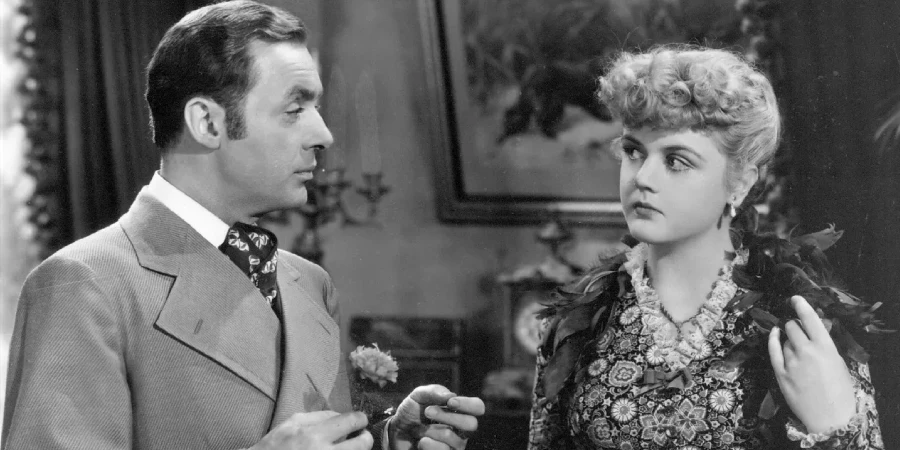
Years later, a now-adult Paula (Ingrid Bergman) finds her singing lessons interrupted by the charming and worldly Gregory Anton (Charles Boyer). He pursues her relentlessly, sweeping her off her feet with a sophisticated romance. Hopelessly in love, Paula abandons her career aspirations and agrees to marry him after a brief courtship.
Return to London
Gregory, however, has a surprising request. He insists they move back to London and live in the very house Paula inherited from her murdered aunt. Despite Paula’s deep misgivings and lingering trauma, she ultimately agrees, wanting to please her new husband and start their life together.
The Mind Games Begin
Once they settle in, Gregory’s behavior shifts dramatically. He begins a systematic campaign of psychological abuse designed to make Paula question her own sanity. For instance, he hides her belongings, like a brooch he gifted her, only to “discover” it later and accuse her of being forgetful and dishonest.
Most notably, he manipulates the gas-powered lights in the house, causing them to dim whenever he is supposedly out. When Paula mentions this, he flatly denies it, convincing her she is imagining things. Furthermore, he isolates her from the outside world, forbidding visitors and questioning her every move until she becomes a nervous wreck, truly believing she is losing her mind.
An Unlikely Ally
Meanwhile, a young Scotland Yard detective named Brian Cameron (Joseph Cotten) takes an interest in Paula. As a boy, he was an ardent admirer of Alice Alquist and has never forgotten her unsolved murder. Seeing Paula, the spitting image of her aunt, move back into the house with a controlling husband piques his professional curiosity.
Cameron’s suspicions grow as he observes Gregory’s strange behavior and Paula’s visible distress. He begins his own covert investigation into Gregory Anton, convinced there is a connection to the cold case from years ago. He uncovers that Gregory has a dark, hidden past.
The Trap is Set
Cameron eventually makes contact with Paula while Gregory is away. He confirms that the flickering gaslights are real, explaining they dim because another light is turned on elsewhere in the house—specifically, in the sealed-off attic. He pieces together the truth: Gregory is secretly searching the attic every night.
He reveals Gregory’s true identity as Sergis Bauer, the same man who murdered Alice Alquist years ago for her priceless jewels. Bauer never found them, and his marriage to Paula was merely a plot to regain access to the house. With Paula’s trust secured, Cameron devises a plan to catch Gregory in the act and finally bring him to justice.



Movie Ending
Brian Cameron instructs Paula to distract Gregory while he searches the house for evidence. Gregory becomes enraged by Paula’s newfound confidence, tying her to a chair before rushing to the attic to continue his search. Up there, Cameron confronts him, and a brief struggle ensues before police swarm the house and apprehend Gregory.
Bound to the chair where he left Paula, Gregory is now the helpless one. In a powerful, cathartic scene, Paula is allowed a final moment alone with him. She pretends to help him, brandishing a knife as if to cut his ropes, but instead psychologically torments him just as he did her. She coolly admits she is “mad” and cannot seem to find the knife, turning his own manipulative tactics against him before he is taken away by Scotland Yard for good.
Are There Post-Credits Scenes?
No, there are no post-credits scenes in Gaslight. The film concludes after Gregory is arrested and driven away.
Type of Movie
Gaslight is a psychological thriller with strong elements of Gothic mystery and film noir. Its tone is overwhelmingly tense and claustrophobic. The film masterfully builds suspense not through action, but through dialogue and the slow, horrifying erosion of a person’s sense of reality, making it a benchmark for the psychological thriller genre.
Cast
- Ingrid Bergman – Paula Alquist Anton
- Charles Boyer – Gregory Anton / Sergis Bauer
- Joseph Cotten – Brian Cameron
- Dame May Whitty – Miss Bessie Thwaites
- Angela Lansbury – Nancy Oliver
Film Music and Composer
The haunting, Oscar-nominated score for Gaslight was composed by Bronisław Kaper. A Polish-born composer known for his lush, romantic, and often suspenseful work at MGM, Kaper’s music is essential to the film’s atmosphere.
The score masterfully reflects Paula’s mental state. It shifts from romantic melodies during her courtship with Gregory to discordant, unsettling themes as her world unravels. The main theme, in particular, enhances the oppressive, Gothic mood of the London townhouse.


Filming Locations
Despite its quintessential London setting, Gaslight was filmed almost entirely on soundstages at the MGM studios in Culver City, California. The production designers, Cedric Gibbons and William Ferrari, won an Academy Award for their incredibly detailed and atmospheric work.
This studio-bound production was a deliberate choice. It allowed director George Cukor to have complete control over the environment, using shadows, cluttered Victorian decor, and the titular gaslights to create a sense of inescapable claustrophobia that a real location might not have provided.
Awards and Nominations
Gaslight was a critical success at the 20th Academy Awards. Ingrid Bergman won the Oscar for Best Actress for her powerful portrayal of Paula. In addition, the film won for Best Art Direction-Interior Decoration, Black-and-White.
The film also received five other nominations. These included Best Picture, Best Actor for Charles Boyer, Best Supporting Actress for a then 17-year-old Angela Lansbury in her film debut, and Best Adapted Screenplay.
Behind the Scenes Insights
- MGM, who produced this version, owned the rights to the 1940 British adaptation of Gaslight. They attempted to purchase and destroy all existing prints of the earlier film to ensure their version was the only one audiences would see.
- Director George Cukor was known as a “woman’s director,” and his sensitive handling of Ingrid Bergman’s performance is credited with helping her win the Oscar.
- Angela Lansbury was only 17 years old during filming and had to be accompanied on set by a guardian. It was her very first movie role, and she earned an Oscar nomination for it.
- Charles Boyer was reportedly hesitant to play such a cruel and villainous character, fearing it would damage his image as a romantic lead.
Inspirations and References
Gaslight is based on the 1938 British stage play Gas Light by Patrick Hamilton. Hamilton was a successful novelist and playwright known for his dark, psychologically driven stories, including the play Rope, which Alfred Hitchcock later adapted.
Alternate Endings and Deleted Scenes
There are no known major alternate endings or significantly deleted scenes for the 1944 version of Gaslight. The film’s final cut has remained the definitive version since its original release, with Paula’s final confrontation with Gregory serving as its intended, powerful climax.
Book Adaptations and Differences
The film is not based on a book but on Patrick Hamilton’s 1938 play, Gas Light. While faithful to the play’s core premise of psychological abuse, the MGM film adaptation makes several key changes. Most significantly, it adds the entire character of Brian Cameron and the Scotland Yard subplot.
In contrast, the original play is a more contained, three-act drama focused almost entirely on the husband and wife inside the house, with a retired detective helping her in the final act. The 1944 film also adds the backstory of Paula’s aunt being a famous opera singer and the murderer’s motive being stolen jewels, which were not part of Hamilton’s original script.

Memorable Scenes and Quotes
Key Scenes
- The Missing Brooch: One of the earliest and most effective moments of gaslighting, where Gregory convinces a frantic Paula that she has lost a brooch he gave her, only for him to “find” it in her handbag where he hid it himself.
- The Lights Dim: The recurring, iconic scene where the gaslights in the drawing-room flicker and dim. Paula sees it clearly, but Gregory insists it is all in her imagination, a lie that erodes her confidence in her own perceptions.
- The Final Confrontation: Paula’s triumphant reversal of power. With Gregory tied to a chair, she taunts him with the possibility of escape, mirroring his own cruel mind games back at him before he is arrested.
Iconic Quotes
- Gregory Anton: “If I were not mad, I could have helped you.”
- Paula Alquist: “Are you trying to tell me that I’m insane?”
- Paula Alquist: “This knife, in my hand. I can’t find it. What a pity. But I’m always losing things. And then I find them again in the most unexpected places.”
Easter Eggs and Hidden Details
- Symbolic Birdcage: Paula is often framed near a birdcage in the house, a visual metaphor for her gilded but trapped existence under Gregory’s control.
- Portrait of the Aunt: The imposing portrait of the murdered Alice Alquist hangs in the house, its eyes seemingly watching over the events and serving as a constant, silent reminder of the past.
- Angela Lansbury’s Mother: The actress who plays the small role of Lady Dalroy, Elizabeth, is Moyna Macgill, who was Angela Lansbury’s real-life mother.
Trivia
- The film’s title and central theme were so impactful that “gaslighting” became a clinical and colloquial term to describe a specific form of manipulative psychological abuse.
- Ingrid Bergman spent time at a mental institution and observed patients to prepare for her role, wanting to understand the nuances of extreme emotional and psychological distress.
- This was the second film adaptation of the play. The first was a 1940 British production directed by Thorold Dickinson, which is also highly regarded but was suppressed by MGM for years.
Why Watch?
This is essential viewing. Ingrid Bergman’s Oscar-winning performance is breathtaking, and Charles Boyer is the perfect charming villain. Its story is the very definition of a psychological thriller, creating a term that endures to this day. It is simply unforgettable cinema.
Director’s Other Movies
- The Philadelphia Story (1940)
- Adam’s Rib (1949)
- A Star Is Born (1954)
- My Fair Lady (1964)
Recommended Films for Fans
- Rebecca (1940)
- Suspicion (1941)
- The Spiral Staircase (1946)
- Sorry, Wrong Number (1948)
- Sleep, My Love (1948)