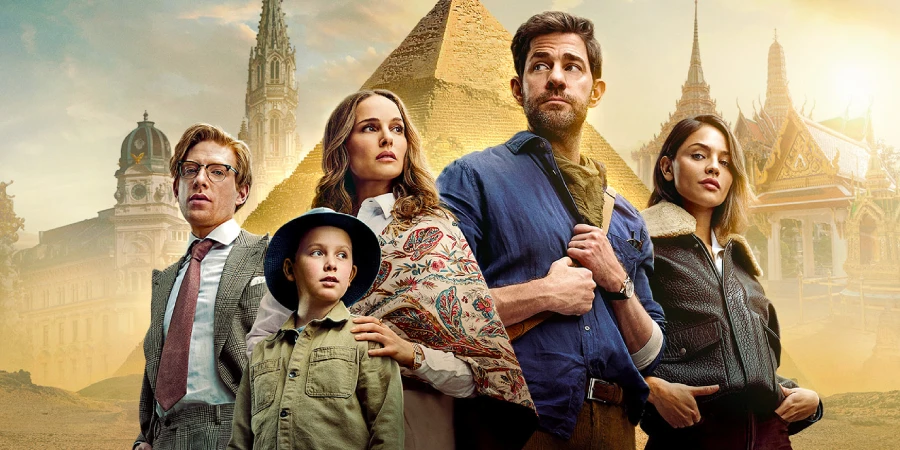

Fountain of Youth (2025) is a globe-trotting adventure film directed by Guy Ritchie, blending myth, history, and modern action into a fast-paced treasure-hunt story. Produced for Apple TV+, the movie leans heavily into classic adventure cinema while adding Ritchie’s signature rhythm, sharp dialogue, and morally gray characters.
Detailed Summary
The Prologue: The Oldest Legend in Human History
The film opens with a historical montage showing how the legend of the Fountain of Youth has appeared in countless civilizations—from Mesopotamian tablets to Spanish conquistador journals. The narration establishes one key idea:
The Fountain does not grant immortality freely. It demands balance.
A hidden map fragment resurfaces in the modern era, triggering a race involving mercenaries, historians, and secret organizations that have guarded the myth for centuries.
Luke Purdue and the Family Legacy
Luke Purdue (John Krasinski) is introduced as a disgraced but brilliant treasure hunter whose father died pursuing mythical artifacts. He believes the Fountain is real, not because of greed, but because he thinks his father discovered its final location before dying.
His estranged sister Charlotte Purdue (Natalie Portman), a museum curator and historian, wants nothing to do with him or legends. She believes myths become dangerous when people try to turn them into science.
Their emotional conflict forms the heart of the film.
The Map That Shouldn’t Exist
Luke steals an encrypted Renaissance-era map from a private collector. The map reveals coordinates scattered across:
- Italy
- Morocco
- Thailand
- Ireland
Each location corresponds to an ancient “trial,” not a clue. The siblings soon learn the Fountain cannot be reached unless all trials are completed in sequence.
Meanwhile, a powerful financier named Owen Carver (Domhnall Gleeson) begins hunting them. He believes the Fountain can cure disease and intends to control it rather than share it.
The Trials of Worth
As the story unfolds, the characters face three major trials:
The Trial of Knowledge: A submerged Roman library that floods unless solved through philosophical riddles.
The Trial of Sacrifice: One character must willingly surrender something deeply personal. Charlotte gives up her academic credibility by destroying proof that could make her famous.
The Trial of Truth: Each character is forced into hallucinations revealing their deepest fear. Luke relives his father choosing the Fountain over saving him as a child.
These trials emphasize that the Fountain responds not to ambition, but to intention.
The Hidden City
The final coordinates lead to a concealed underground city beneath Ireland’s Giant’s Causeway. The Fountain is revealed not as a pool, but as a living biome powered by an ancient organism that manipulates cellular regeneration.
The city was built to contain it after ancient civilizations realized eternal life destabilized society.

Movie Ending
The climax occurs inside the Fountain chamber itself.
Carver reaches the core first and activates the mechanism, causing uncontrolled regeneration throughout his body. At first, he appears healed and powerful. Moments later, his cells begin replicating endlessly, turning him into a living paradox. He disintegrates into organic matter, confirming the legend: immortality without balance equals destruction.
Luke then discovers the truth about his father.
His father reached the Fountain years earlier and chose not to use it. Instead, he sealed it again, knowing that humanity was not ready. His death was not caused by the Fountain, but by mercenaries trying to reopen it.
Charlotte realizes the Fountain is semi-sentient. It reacts to emotional intent rather than commands.
Luke is offered a choice.
He can restore his father and erase decades of pain, or permanently shut down the Fountain so it can never be exploited again.
He chooses destruction.
The siblings activate the final safeguard, collapsing the ancient city and allowing the organism to dissolve into the earth. The Fountain of Youth ceases to exist.
In the final moments, Luke nearly dies during the collapse but survives. He does not become immortal. No one does.
The film ends with Charlotte publishing the truth as a historical allegory rather than factual proof, protecting the world from repeating the cycle.
The last line of dialogue: “Some things aren’t meant to last forever. Especially us.”
Are There Post-Credits Scenes?
Yes, there is one mid-credits scene.
It shows a sealed Vatican archive where a small glowing root begins to grow inside a stone reliquary labeled: “Fragment: Unknown Origin.”
This strongly suggests that the Fountain may not be entirely gone.
There is no post-credits scene after the full credits.
Type of Movie
Fountain of Youth is a mythological action-adventure film that blends historical mystery, globe-trotting exploration, and character-driven drama. It combines classic treasure-hunt storytelling with modern pacing and philosophical themes about mortality.
Cast
- John Krasinski – Luke Purdue
- Natalie Portman – Charlotte Purdue
- Domhnall Gleeson – Owen Carver
- Eiza González – Esme Reyes
- Stanley Tucci – Professor Leclerc
- Laz Alonso – Captain Morales
Film Music and Composer
The score was composed by Christopher Benstead, a frequent collaborator of Guy Ritchie.
The music mixes orchestral adventure themes with modern percussion, echoing classic films like Indiana Jones while maintaining a contemporary tone.
Filming Locations
- Italy (Rome and Florence): Used for ancient library ruins and Vatican-style interiors.
- Morocco (Atlas Studios): Served as desert ruins and underground passages.
- Thailand: Jungle temple sequences and water trials.
- United Kingdom (Northern Ireland): The Giant’s Causeway forms the visual basis of the hidden city.
These locations reinforce the idea that the Fountain myth exists across all civilizations, not one culture.
Awards and Nominations
As of early 2026, the film has received:
- Nominations for Best Visual Effects at several technical guild awards
- Best Original Score nomination at the Hollywood Music in Media Awards
Major awards recognition has been modest, but audience response has been strong.
Behind the Scenes Insights
- Guy Ritchie rewrote large portions of the script during rehearsals to improve sibling dialogue.
- Natalie Portman insisted Charlotte remain intellectually driven rather than becoming a typical action heroine.
- Practical sets were used for most ruins, with CGI added only for expansion.
- The underwater library scene took nearly three weeks to shoot.
- John Krasinski performed many of his own stunts, including the final collapse sequence.
Inspirations and References
- Indiana Jones series
- National Treasure (2004)
- Uncharted video game franchise
- The Epic of Gilgamesh
- Real historical myths surrounding Ponce de León
The Fountain itself draws heavily from ancient texts describing immortality as a curse rather than a blessing.
Alternate Endings and Deleted Scenes
A deleted ending showed Luke briefly healing from a fatal wound, implying partial immortality. This was removed because test audiences felt it contradicted the film’s theme.
Another deleted scene explored a secret society called The Keepers of the Spring, which may reappear if a sequel is made.
Book Adaptations and Differences
The film is not directly adapted from a book, but loosely inspired by historical legends and mythological texts. No novelization has been released.
Memorable Scenes and Quotes
Key Scenes
- The flooded Roman library puzzle sequence
- The hallucination chamber revealing Luke’s childhood trauma
- The reveal that the Fountain is a living organism
- The city collapse beneath the Giant’s Causeway
Iconic Quotes
“The problem with living forever is watching everyone else die.”
“History isn’t written by survivors. It’s written by those who let go.”
“You don’t protect humanity by saving it from death.”

Easter Eggs and Hidden Details
- A mural depicts figures resembling Indiana Jones and Lara Croft silhouettes.
- The map symbols match real alchemical glyphs.
- One artifact references the Ark of the Covenant with altered lettering.
- The Vatican archive code number matches the year 1513, linked to Ponce de León.
Trivia
- The film took over four years to develop.
- Apple reportedly approved the project based on a single storyboard reel.
- The Fountain organism design was inspired by coral reefs and neural networks.
- Over 800 visual effects shots were used.
Why Watch?
You should watch Fountain of Youth (2025) if you enjoy:
- Classic adventure storytelling
- Historical mysteries with emotional weight
- Sibling-driven character drama
- Fast-paced but intelligent action
- Films that ask philosophical questions beneath spectacle
It’s not just about immortality. It’s about knowing when to let go.
Director’s Other Works (Guy Ritchie)
- Lock, Stock and Two Smoking Barrels (1998)
- Snatch (2000)
- Sherlock Holmes (2009)
- Sherlock Holmes: A Game of Shadows (2011)
- The Man from U.N.C.L.E. (2015)
- King Arthur: Legend of the Sword (2017)
- Wrath of Man (2021)
- The Covenant (2023)