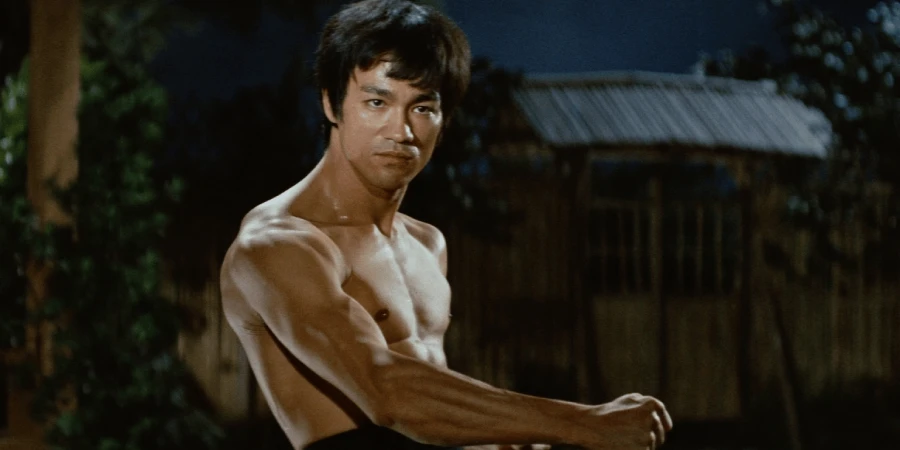
Fist of Fury is one of the most influential martial arts films ever made and a cornerstone of Bruce Lee’s legendary screen persona. Released in 1972 and directed by Lo Wei, the film blends explosive kung fu action with themes of national pride, oppression, and righteous vengeance.
Detailed Summary
The Death of the Master
The story begins in early-20th-century Shanghai. Chen Zhen (Bruce Lee), a top student of the Jing Wu Martial Arts School, returns from an absence only to learn that his beloved master, Huo Yuanjia, has died under mysterious circumstances. The school is already under pressure from a rival Japanese dojo, whose students openly insult the Chinese martial artists and view them as inferior.
This moment sets the emotional backbone of the film: loss, humiliation, and restrained rage.
The Insult and the Breaking Point
The Japanese dojo sends a sign reading “Sick Man of Asia” to mock the Jing Wu school. Chen Zhen, unable to tolerate the insult, storms the dojo alone and defeats every fighter inside using his bare hands. This iconic sequence establishes Bruce Lee’s screen image as uncontainable physical and moral force.
Poison and Betrayal
Chen Zhen secretly investigates his master’s death and discovers that Huo Yuanjia was poisoned, not killed by illness. Evidence points to collaboration between Japanese occupiers and a traitor within the Chinese community. This revelation turns the film from a revenge drama into a political and moral confrontation.
Escalation and Bloodshed
As Chen Zhen retaliates, violence escalates. Japanese fighters are killed, and Chen becomes a wanted man. Meanwhile, Jing Wu students are attacked, and the school is pushed toward destruction. Chen’s romantic relationship suffers as his obsession with vengeance consumes him.
The Noose Tightens
The Japanese authorities, aided by colonial police, corner Chen Zhen. Jing Wu elders beg him to stop, knowing that his actions will bring catastrophic consequences. Chen, fully aware, chooses to continue.
Movie Ending
In the final act, Chen Zhen accepts his fate. He understands that there is no escape and that surrender would mean public humiliation and the destruction of Jing Wu’s honor. After ensuring the safety of his fellow students, he walks alone toward the Japanese-controlled compound.
Surrounded by enemy fighters and police armed with rifles, Chen removes his outer garment, symbolically shedding fear and restraint. In a powerful, slow-motion moment, he leaps into the air, flying kick aimed forward, knowing he will be shot mid-air.
Gunshots ring out as his body freezes in motion. The film ends without showing him hit the ground, immortalizing Chen Zhen as a martyr rather than a victim. His death becomes a final act of defiance, leaving the audience with unresolved grief but undeniable admiration.
Are There Post-Credits Scenes?
No. Fist of Fury ends abruptly with its iconic freeze-frame finale. There are no post-credits or mid-credits scenes, which reinforces the film’s tragic and definitive tone.
Type of Movie
Fist of Fury is a martial arts action drama rooted in historical fiction, combining kung fu cinema with themes of colonial resistance and personal revenge.
Cast
- Bruce Lee as Chen Zhen
- Nora Miao as Yuan Le-erh
- James Tien as Fan Chun-hsia
- Maria Yi as Japanese school instructor
- Han Ying-chieh as Petrov
Film Music and Composer
The score was composed by Joseph Koo, featuring dramatic orchestral themes that heighten emotional tension. The music alternates between somber melodies during moments of loss and sharp, rhythmic cues during fight scenes.
Filming Locations
The film was shot primarily in Hong Kong, with sets recreating 1910s Shanghai. These locations were crucial in conveying:
- The oppressive atmosphere of foreign-controlled territory
- The cultural divide between Chinese and Japanese communities
- The claustrophobic tension surrounding the Jing Wu school
Though modest by modern standards, the sets effectively support the film’s emotional weight.
Awards and Nominations
While Fist of Fury did not receive major international awards at the time, it achieved:
- Massive box office success in Asia
- Long-term critical recognition as one of the most influential martial arts films in history
Its legacy far outweighs its formal accolades.
Behind the Scenes Insights
- Bruce Lee choreographed much of the fight choreography himself
- Several fight scenes were filmed in long takes to showcase real martial skill
- The film was rushed into production due to the success of The Big Boss (1971)
- Bruce Lee insisted on reducing wire work to emphasize realism
- Some scenes were censored or trimmed in early international releases due to violence
Inspirations and References
- Inspired by the real-life Jing Wu Athletic Association
- Draws on Chinese nationalist sentiment during Japanese occupation
- Influenced later revenge-driven martial arts films and characters, including Kill Bill
Alternate Endings and Deleted Scenes
- Early drafts reportedly considered Chen Zhen being arrested instead of killed
- Deleted scenes included extended training sequences and more school politics
- The final freeze-frame ending was chosen to create a mythic, unforgettable image
Book Adaptations and Differences
Fist of Fury is not based on a novel. However, later novelizations and remakes expanded on:
- Chen Zhen’s backstory
- The political environment
- His romantic relationship
The original film remains more direct and emotionally raw.

Memorable Scenes and Quotes
Key Scenes
- Chen Zhen destroying the “Sick Man of Asia” sign
- The dojo massacre scene
- The final slow-motion leap toward armed soldiers
Iconic Quotes
- “We are not sick men.”
- “I am Chinese.”
- “If you want to fight, fight with honor.”
Easter Eggs and Hidden Details
- Jing Wu banners feature real historical slogans
- Bruce Lee’s fighting style blends Jeet Kune Do concepts with traditional kung fu
- Chen Zhen’s costume subtly darkens as his morality hardens
- Japanese uniforms reflect actual early-20th-century military design
Trivia
- The film broke box office records in Hong Kong upon release
- Bruce Lee’s screams were deliberately exaggerated to unsettle opponents
- Quentin Tarantino cited this film as a major influence
- The character Chen Zhen was reused in later films and TV adaptations
Why Watch?
Because Fist of Fury is not just a kung fu movie—it’s a cultural statement. It captures Bruce Lee at his most intense, channels historical anger into cinematic power, and delivers one of the most unforgettable endings in film history.
Director’s Other Works
- The Big Boss (1971)
- Way of the Dragon (1972) – co-directed
- Enter the Dragon (1973) – producer
- The Tattooed Dragon (1973)