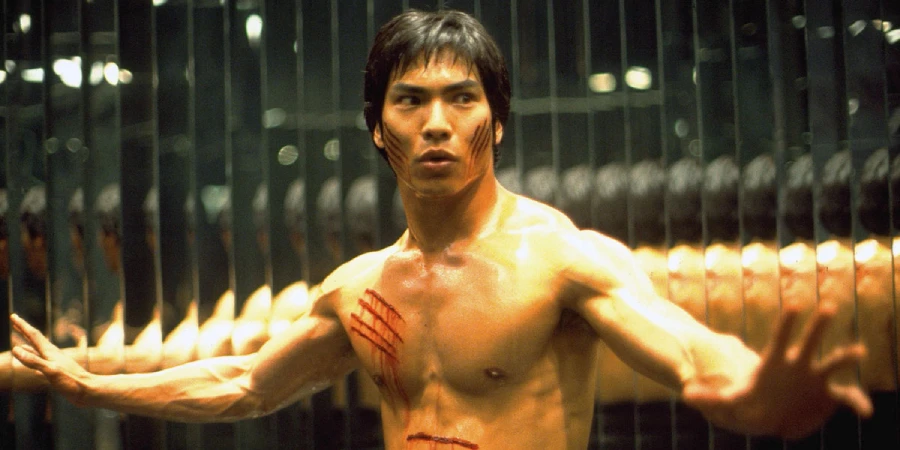

Dragon: The Bruce Lee Story is a biographical martial arts drama that blends legend, myth, and real-life struggle into a cinematic portrait of Bruce Lee. Directed by Rob Cohen, the film does not aim to be a strict documentary; instead, it presents Bruce Lee’s life as an epic hero’s journey, complete with symbolism, romance, and inner demons.
Detailed Summary
Bruce Lee’s Early Life and the Seeds of Conflict
The film begins in Hong Kong, portraying Bruce Lee as a talented but troubled young man struggling with violence and street fights. His parents worry about his future, especially after a brutal gang confrontation convinces them that Hong Kong may destroy him rather than shape him.
Bruce is sent to the United States, a decision that becomes the turning point of his life. From the very beginning, the movie emphasizes Bruce’s dual battle: external racism and internal self-doubt.
America, Racism, and the Birth of a Fighter
In San Francisco and later Seattle, Bruce faces discrimination from both American society and traditional Chinese martial arts masters. He enrolls in college, studies philosophy, and begins teaching martial arts to anyone willing to learn—a radical idea at the time.
This choice leads to conflict with the Chinese martial arts community, who believe kung fu should not be taught to outsiders. The tension culminates in a legendary duel that tests Bruce physically and spiritually, pushing him to rethink combat itself.
Love and Partnership: Bruce and Linda
Bruce meets Linda Emery, who becomes his emotional anchor and future wife. Their relationship is portrayed as deeply supportive, though not without strain. Linda stands by Bruce as he chases his dream of redefining martial arts and breaking into entertainment, even when success feels impossibly distant.
Their love story humanizes Bruce, showing him not as a flawless icon, but as a man driven by fear of failure and an obsessive desire to prove himself.
Hollywood Struggles and Cultural Barriers
Bruce moves to Hollywood, where he encounters systemic racism. Despite his talent, studios refuse to cast him as a leading man. He creates martial arts choreography, teaches celebrities, and lands a role on The Green Hornet, yet remains frustrated by being sidelined.
One of the film’s strongest themes emerges here: Bruce Lee is too Asian for Hollywood, yet not traditional enough for the old kung fu world.
The Demon and the Mind
Throughout the film, Bruce is haunted by visions of a demonic warrior. This figure represents fear, destiny, and self-destruction. As Bruce pushes his body to the extreme, the demon becomes more aggressive, symbolizing the cost of ambition and obsession.
This supernatural element is fictional but serves as a metaphor for Bruce’s internal struggle.
International Fame and the Final Test
Bruce returns to Hong Kong and finally achieves stardom with films that revolutionize martial arts cinema. His success brings recognition, wealth, and influence—but also exhaustion and physical breakdown.
The demon returns one last time, leading to a climactic spiritual confrontation that mirrors Bruce’s lifelong struggle between control and chaos.
Movie Ending
In the final act, Bruce Lee confronts the demonic figure that has haunted him throughout the film. This confrontation takes place in a symbolic, dreamlike setting rather than a literal battlefield. The fight represents Bruce facing his fears: failure, death, and the consequences of pushing himself beyond human limits.
Bruce ultimately defeats the demon, symbolizing inner peace and self-acceptance. Shortly afterward, the film shows Bruce enjoying a quiet, intimate moment with Linda and their child, suggesting that he has finally found balance between ambition and family.
The movie then transitions to a somber conclusion, acknowledging Bruce Lee’s sudden death in 1973 at the age of 32. Rather than focusing on the mystery surrounding his death, the film emphasizes his legacy: a man who changed martial arts, cinema, and cultural representation forever. The final scenes remind the audience that although Bruce’s life was short, his influence was permanent.
Are There Post-Credits Scenes?
No, Dragon: The Bruce Lee Story does not include any post-credits or mid-credits scenes. The story ends definitively with its tribute to Bruce Lee’s legacy.
Type of Movie
This film is a biographical martial arts drama that blends real events with mythic storytelling. It focuses as much on Bruce Lee’s inner struggles as it does on his physical achievements.
Cast
- Jason Scott Lee as Bruce Lee
- Lauren Holly as Linda Lee
- Robert Wagner as Bill Krieger
- Michael Learned as Vivian Emery
- Nancy Kwan as Gussie Yang
Film Music and Composer
The score was composed by Randy Edelman, whose music adds emotional weight and a heroic tone to Bruce Lee’s journey. The soundtrack blends orchestral drama with subtle Eastern influences, reinforcing the film’s mythic atmosphere.
Filming Locations
The movie was filmed in:
- Hong Kong, capturing Bruce Lee’s roots and cultural background
- Seattle, representing Bruce’s formative years in America
- Los Angeles, symbolizing Hollywood’s promise and prejudice
These locations are crucial in showing Bruce’s transition from local fighter to global icon.
Awards and Nominations
While the film did not receive major Academy Award nominations, it was praised for Jason Scott Lee’s performance and became a cult favorite among martial arts fans. It also received recognition at genre-focused and international film festivals.
Behind the Scenes Insights
- Jason Scott Lee is not related to Bruce Lee but underwent intense martial arts training for the role
- Linda Lee Cadwell served as a consultant but later noted the film was more myth than biography
- Bruce Lee’s daughter, Shannon Lee, has stated the film captures the spirit rather than the facts of her father’s life
- The demon character was created purely for symbolic storytelling and has no basis in Bruce Lee’s real experiences
Inspirations and References
- Bruce Lee’s real-life philosophy and writings
- Bruce Lee: The Man Only I Knew by Linda Lee Cadwell
- Traditional Chinese folklore and spiritual symbolism
- Classic Hollywood biopics structured like heroic epics
Alternate Endings and Deleted Scenes
Several scenes exploring Bruce’s declining health in more detail were reportedly trimmed to maintain pacing. No fully alternate ending has been released, but early drafts leaned more heavily into mystery surrounding his death, which was later avoided.
Book Adaptations and Differences
The film is loosely based on Linda Lee Cadwell’s book. Key differences include:
- The demon subplot is entirely fictional
- Events are compressed or rearranged for dramatic effect
- Bruce’s career struggles are exaggerated to fit a classic underdog narrative
Memorable Scenes and Quotes
Key Scenes
- Bruce’s duel with the traditional kung fu master
- His first major Hollywood rejection
- The symbolic battle with the demon
- Bruce teaching martial arts to a diverse group of students
Iconic Quotes
- “I do not believe in systems. I believe in the individual.”
- “You have to learn to let go.”
Easter Eggs and Hidden Details
- Bruce Lee’s real philosophical quotes appear subtly rewritten in dialogue
- Fight choreography references moves from Bruce’s actual films
- The demon’s armor design resembles traditional Chinese opera costumes
Trivia
- Jason Scott Lee performed most of his own stunts
- Bruce Lee’s real family name, Li, is briefly referenced in background dialogue
- The film helped renew global interest in Bruce Lee during the 1990s
Why Watch?
If you want a stylized, emotional, and inspirational take on Bruce Lee’s life rather than a strict documentary, this film delivers. It’s about identity, perseverance, and cultural impact as much as martial arts.
Director’s Other Works
- The Fast and the Furious (2001)
- xXx (2002)
- Daylight (1996)
- The Skulls (2000)