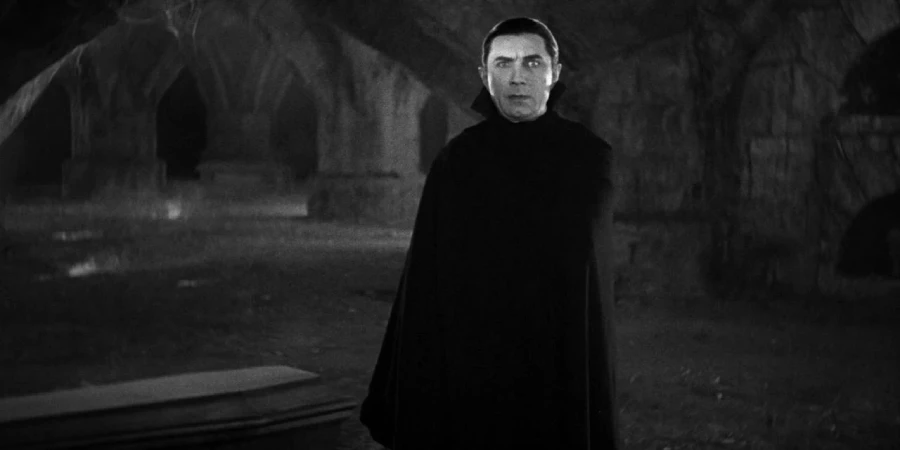

Bela Lugosi’s hypnotic gaze seared into cinematic consciousness long before jump scares became horror’s staple. Tod Browning’s Dracula did not rely on gore; instead, it built a foundation of dread with silence, shadow, and a single, unforgettable performance. This film defined the vampire for generations. It remains a masterclass in atmospheric terror.
Detailed Summary
Renfield’s Arrival in Transylvania
English solicitor Renfield travels to the Carpathian Mountains, ignoring dire warnings from local villagers. He is meeting a client, Count Dracula, to finalize a real estate transaction in London. After a harrowing carriage ride through Borgo Pass, Renfield arrives at a crumbling, cobweb-infested Castle Dracula.
Count Dracula makes a grand entrance, descending a massive staircase. He is impeccably dressed and unnervingly charming. After Renfield accidentally cuts his finger, Dracula’s civilized facade cracks for a moment, revealing a primal hunger before he regains his composure.
A Voyage of the Damned
Drugged by the Count, Renfield becomes Dracula’s thrall. They board the schooner Vesta, bound for England. The voyage, however, turns into a nightmare as Dracula systematically preys on the crew.
Consequently, the ship arrives in Whitby as a ghost vessel. A lone survivor, the now-maniacal Renfield, is discovered tied to the helm, laughing hysterically. He is promptly committed to Dr. Seward’s sanatorium, located next to Carfax Abbey, the property Dracula has just purchased.
Seduction in London
Dracula, now an exotic nobleman, immediately integrates into London society. He attends the theatre and meets Dr. Seward, his daughter Mina, her fiancé John Harker, and Mina’s friend Lucy Weston. Dracula’s charm is potent, particularly on the women.
Lucy quickly falls under his spell, becoming his first English victim. She wastes away and dies, only to rise again as a vampire herself, preying on small children. Meanwhile, Dracula turns his predatory attention to Mina.
Van Helsing’s Investigation
Dr. Seward, alarmed by Lucy’s death and Mina’s sudden decline, calls upon his colleague, Professor Van Helsing. A specialist in obscure diseases and ancient folklore, Van Helsing quickly suspects the horrifying truth. He finds telltale bite marks on Mina’s neck.
A tense confrontation occurs between Dracula and Van Helsing. The professor uses a mirror to prove Dracula casts no reflection, confirming he is a vampire. Subsequently, Van Helsing dedicates himself to protecting Mina and destroying the monster.
The Final Confrontation
Dracula’s influence over Mina grows stronger. He attempts to spirit her away to his castle, promising her eternal life as his bride. Renfield, in a moment of clarity, begs his master not to harm Mina, but Dracula kills him for his defiance.
Harker and Van Helsing pursue Dracula to Carfax Abbey just as the sun rises. They know the vampire must rest in his coffin during the day. This provides them the perfect opportunity to strike.

Movie Ending
The ending of Dracula is swift and surprisingly understated. Following Dracula into the abbey’s crypt, Harker and Van Helsing find the Count sleeping in his coffin. While Harker goes to comfort a recovering Mina, Van Helsing takes decisive action.
We do not see the staking. Instead, the camera stays outside the crypt as a loud, guttural groan echoes from within. Van Helsing then emerges, confirming the deed is done. Mina is freed from the vampire’s curse, and the film concludes with her and Harker ascending the stairs, leaving the darkness behind.
Are There Post-Credits Scenes?
No, there are no post-credits scenes in the 1931 version of Dracula. Post-credits scenes were not a common filmmaking practice during Hollywood’s Golden Age. The film ends definitively with the monster’s demise and the hero’s triumph.
Type of Movie
Dracula is a quintessential Gothic horror film. It eschews modern jump scares for a slow-burning sense of dread and psychological terror. Its tone is somber and atmospheric, relying heavily on suggestive shadows, eerie silence, and the power of its central performance to create suspense.
Cast
- Bela Lugosi – Count Dracula
- Helen Chandler – Mina Seward
- David Manners – John Harker
- Dwight Frye – Renfield
- Edward Van Sloan – Professor Van Helsing
- Herbert Bunston – Doctor Seward
- Frances Dade – Lucy Weston
Film Music and Composer
Interestingly, the original theatrical release of Dracula has no original film score. Aside from a modified excerpt from Tchaikovsky’s Swan Lake during the opening credits and a snippet of Wagner during the theatre scene, the film is largely silent.
This lack of music was a deliberate choice by director Tod Browning. He believed silence would make the dialogue and sound effects more jarring and unsettling. In 1998, however, composer Philip Glass was commissioned to write a brand new, modern score for the film’s re-release on home video, which offers a very different viewing experience.
Filming Locations
Despite its European setting, Dracula was filmed entirely in California on the Universal Studios backlot. The massive sets for Castle Dracula, Carfax Abbey, and the London theatre were all constructed on soundstages. Director Tod Browning used stark, expressionistic-style sets to amplify the film’s gothic and otherworldly atmosphere.
Awards and Nominations
Tod Browning’s Dracula received no major awards or nominations upon its release. Its legacy, however, has far surpassed any contemporary accolades, cementing its place as a cornerstone of the horror genre.
Behind the Scenes Insights
- Director Tod Browning had recently worked with Lon Chaney on several silent films. Chaney was the studio’s first choice for Dracula, but he tragically passed away from cancer before production began.
- Bela Lugosi, who had played the role on Broadway to great acclaim, campaigned heavily for the part. He ultimately accepted a very low salary of $500 per week to secure his iconic role.
- Universal simultaneously filmed a Spanish-language version of Dracula at night on the same sets, using a different cast and crew. Many critics and film historians consider this version, directed by George Melford, to be technically superior.
- Lugosi barely spoke English when cast and learned many of his lines phonetically. This contributed to his unique, deliberate, and hypnotic vocal delivery.
Inspirations and References
The film is based on the 1924 stage play by Hamilton Deane and John L. Balderston. This play, in turn, was an adaptation of Bram Stoker’s seminal 1897 novel, Dracula. The film borrows more heavily from the play’s streamlined structure than the book’s complex narrative.
Alternate Endings and Deleted Scenes
The film originally concluded with an epilogue delivered by Edward Van Sloan (Van Helsing). He stepped out from behind a curtain to address the audience directly, warning them that “there are such things as vampires.” This scene was often cut from re-releases by censors who felt it was too frightening for audiences.
There are no known deleted scenes or alternate endings in terms of plot. The narrative presented in the final cut is the one that was shot and intended for release.
Book Adaptations and Differences
The 1931 film significantly condenses Bram Stoker’s novel. It follows the stage play’s lead by merging and eliminating characters. For instance, the novel’s Mina Murray and Lucy Westenra are combined, and characters like Quincey Morris and Arthur Holmwood are entirely absent.
Furthermore, the setting is changed from Whitby to London, and Jonathan Harker’s initial journey is given to Renfield. Most notably, the book’s epic, continent-spanning chase to destroy Dracula is reduced to a final confrontation within the confines of Carfax Abbey.
Memorable Scenes and Quotes
Key Scenes
- Dracula’s Entrance: The Count’s slow, deliberate descent down his castle staircase, cloaked in shadow, is one of cinema’s most famous character introductions.
- The Mirror Scene: Van Helsing confronts Dracula with a cigarette case, revealing the vampire has no reflection. This moment of supernatural confirmation is a turning point in the film.
- Renfield’s Ravings: Dwight Frye’s unhinged performance as the fly-eating Renfield provides some of the film’s most genuinely disturbing moments.
Iconic Quotes
- “Listen to them. Children of the night. What music they make!”
- “I never drink… wine.”
- “For one who has not lived even a single lifetime, you are a wise man, Van Helsing.”
- “The spider spinning his web for the unwary fly. The blood is the life, Mr. Renfield.”
Easter Eggs and Hidden Details
- An armadillo can be seen scuttling around Castle Dracula’s dungeon. This out-of-place creature was likely just on set from another production and was included as a bizarre, unsettling detail.
- The massive spider webs in Dracula’s castle were created by shooting rubber cement from a special gun, a common practical effect of the era.
- When Dracula attacks the flower girl in London, the camera cuts away. However, in the Spanish-language version filmed on the same set, the attack is shown more explicitly.
Trivia
- Bela Lugosi became so typecast as Dracula that his career suffered greatly. He was ultimately buried in one of his signature Dracula capes.
- Despite being a horror icon, director Tod Browning only directed one other major horror film for Universal, the highly controversial Freaks (1932).
- Dwight Frye, who played Renfield, was also typecast in “crazed” roles for the rest of his career, most notably as Fritz in Frankenstein (1931).
- Universal Pictures did not own the film rights to the novel, only to the stage play. This is why the film’s structure more closely mirrors the play.
Why Watch?
This film is essential viewing. It is the blueprint for the cinematic vampire and a landmark of horror history. Bela Lugosi’s performance is iconic, defining a character for all time with sheer presence and a chilling accent. Watch it for a masterclass in atmosphere.
Director’s Other Movies
- The Unholy Three (1925)
- The Unknown (1927)
- Freaks (1932)
- Mark of the Vampire (1935)
- The Devil-Doll (1936)
Recommended Films for Fans
- Frankenstein (1931)
- The Mummy (1932)
- Nosferatu (1922)
- White Zombie (1932)
- The Wolf Man (1941)