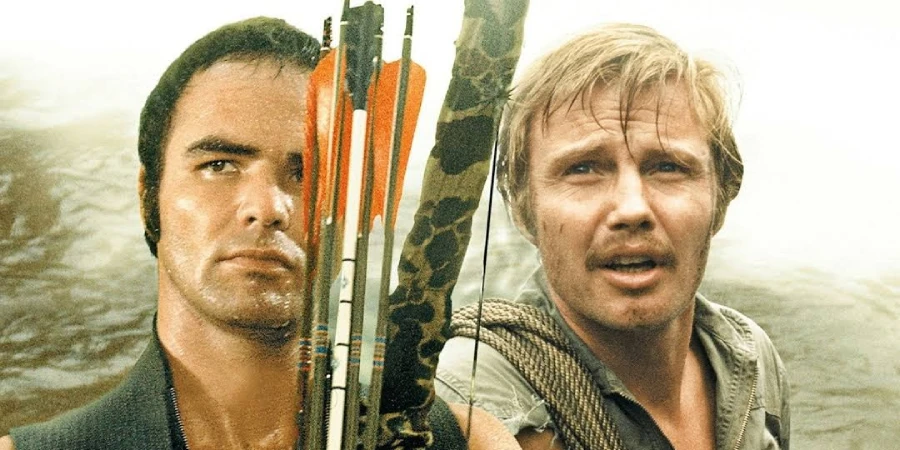

John Boorman’s Deliverance is one of the most disturbing and influential American films of the 1970s. What begins as a simple outdoor adventure slowly mutates into a nightmare about masculinity, civilization, and the thin line between modern order and primal chaos. This is not an easy watch, but it is an unforgettable one.
Detailed Summary
Four Men, One Last Adventure
The film follows four suburban friends from Atlanta who decide to take a canoe trip down the Cahulawassee River before it is flooded by a hydroelectric dam project.
- Ed (Jon Voight) is the quiet everyman and emotional center.
- Lewis (Burt Reynolds) is the survivalist, alpha male who romanticizes nature and self-reliance.
- Bobby (Ned Beatty) is insecure, talkative, and physically unprepared.
- Drew (Ronny Cox) is gentle, musically inclined, and deeply uneasy about the trip.
From the start, the film subtly warns the audience that this is not just a recreational journey. Locals eye the men with hostility, and the environment itself feels indifferent at best, threatening at worst.
The Banjo Duel: An Uneasy Cultural Clash
One of the most iconic scenes occurs early on when Drew plays guitar and engages in a musical duel with a local boy on banjo.
On the surface, it’s charming. Beneath it, the moment highlights:
- The disconnect between urban outsiders and rural locals
- The sense that the visitors are being observed and judged
- A foreboding suggestion that communication does not equal understanding
Violence Breaks the Illusion
The trip turns horrific when Bobby and Ed are ambushed by two local men. What follows is one of the most shocking scenes in American cinema: Bobby is sexually assaulted at gunpoint while Ed is forced to watch.
This moment permanently fractures the group. Civilization, law, and morality suddenly feel very far away. Lewis kills one of the attackers with an arrow, and the men must decide what to do next.
A Dead Man, A Dangerous Choice
The group chooses to bury the body and say nothing, fearing that no one will believe their story and that the local community will turn against them. Drew strongly objects, insisting they report the crime, but he is overruled.
From this point on, the film becomes a study in moral erosion:
- Survival replaces justice
- Fear overrides ethics
- Silence becomes complicity
The River Turns Deadly
As they continue down the river, Drew is mysteriously killed, possibly shot from the riverbank, though this is never definitively proven. Lewis is badly injured in a rafting accident, leaving Ed to take on the role of protector and decision-maker.
Ed is forced into a final confrontation with what may be the second attacker, culminating in a brutal, ambiguous killing that leaves both Ed and the audience unsure of the truth.


Movie Ending
Ed returns to town with Lewis, claiming that Drew’s death was an accident caused by rough waters. The sheriff questions him, especially about a local man with a broken arm, but there is no concrete evidence. Ed lies calmly and convincingly, fully transformed from the passive man he was at the beginning.
Lewis survives but is permanently physically damaged, confined to a hospital bed. His philosophy of survival and dominance has proven hollow and destructive.
In the final moments, Ed returns to his suburban life, but peace does not return with him. In the film’s haunting last image, he wakes from a nightmare, seeing a hand rise from the river, reaching for him.
This final vision suggests:
- Guilt cannot be buried as easily as a body
- The wilderness has permanently invaded his psyche
- Survival came at the cost of innocence and moral certainty
The film ends without redemption, justice, or closure, emphasizing that some experiences cannot be escaped, only endured.
Are There Post-Credits Scenes?
No. Deliverance has no post-credits scenes. The film ends abruptly and deliberately, leaving the audience to sit with its discomfort and unresolved questions.
Type of Movie
Deliverance is a psychological survival thriller with strong elements of adventure and horror. It is less about action and more about the collapse of social norms under extreme pressure.
Cast
- Jon Voight – Ed Gentry
- Burt Reynolds – Lewis Medlock
- Ned Beatty – Bobby Trippe
- Ronny Cox – Drew Ballinger
- James Dickey – Sheriff Bullard (cameo)
Film Music and Composer
The score was composed by Eric Weissberg, blending sparse orchestration with traditional folk elements. The use of music is minimal, allowing natural sounds—water, wind, silence—to dominate, making the violence feel more real and intrusive.


Filming Locations
The film was shot primarily in Rabun County, Georgia, along the Chattooga River.
This location was crucial because:
- The river is real, dangerous, and unpredictable
- Many scenes were shot without stunt doubles
- The environment itself functions as an antagonist
The authenticity of the setting contributes heavily to the film’s realism and tension.
Awards and Nominations
- Academy Award nominations:
- Best Picture
- Best Director (John Boorman)
- Best Film Editing
- Widely praised by critics and later preserved in the U.S. National Film Registry for cultural significance
Behind the Scenes Insights
- Burt Reynolds was seriously injured during filming and refused to stop shooting
- Ned Beatty was not fully informed about the sexual assault scene beforehand to preserve authenticity
- Canoeing scenes were genuinely dangerous and not simulated
- James Dickey, the author of the novel, insisted on appearing in the film
Inspirations and References
The film is based on the 1970 novel “Deliverance” by James Dickey, who drew inspiration from:
- Southern Appalachian culture
- His own experiences with wilderness survival
- Themes of modern masculinity confronting primal fear
Alternate Endings and Deleted Scenes
No radically different ending was filmed, but:
- Several extended dialogue scenes were removed to keep tension high
- Boorman intentionally avoided clarifying whether Drew was shot, maintaining ambiguity
Book Adaptations and Differences
The film is largely faithful to the novel, but:
- The book delves deeper into Ed’s internal thoughts
- The novel provides more philosophical commentary on violence
- The film emphasizes visual and emotional impact over introspection

Memorable Scenes and Quotes
Key Scenes
- The banjo duel between Drew and the local boy
- Bobby’s assault scene and its devastating aftermath
- Ed’s solo climb and final confrontation
- The final nightmare image of the river hand
Iconic Quotes
- Lewis: “This is the way the world is. People have forgotten it.”
- Ed: “I don’t think you believe what you’re saying.”
Easter Eggs and Hidden Details
- The dam project referenced mirrors real 1970s infrastructure expansion in the South
- The locals’ hostility subtly increases before violence occurs
- The sheriff’s calm demeanor contrasts sharply with Ed’s internal panic
Trivia
- The banjo piece is titled “Dueling Banjos” and became a pop culture phenomenon
- The film helped redefine the survival thriller genre
- Burt Reynolds later said this was the best film he ever made
Why Watch?
You should watch Deliverance if you’re interested in:
- Psychological tension over cheap scares
- Films that challenge moral comfort
- Stories where survival has a price
This is not entertainment in the easy sense—it is cinema that tests the viewer.
Director’s Other Works (Movies)
- Point Blank (1967)
- Zardoz (1974)
- Excalibur (1981)
- Hope and Glory (1987)
Recommended Films for Fans
- Straw Dogs (1971)
- The Texas Chain Saw Massacre (1974)
- Southern Comfort (1981)
- The Edge (1997)
- No Country for Old Men (2007)