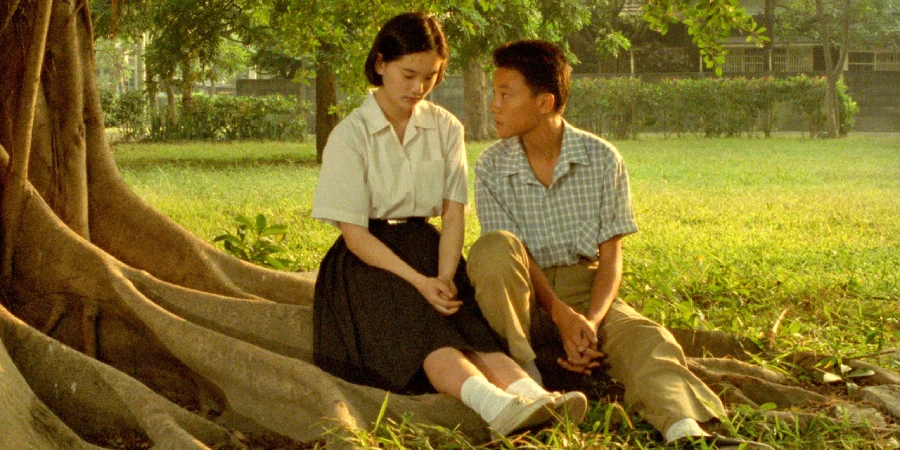
Edward Yang’s A Brighter Summer Day (1991) is often called one of the greatest films ever made, a monumental Taiwanese epic that blends coming-of-age drama, political tension, gang culture, and personal tragedy.
Detailed Summary: Key Moments
The World of 1960s Taiwan
Set in early-1960s Taipei, the film follows 14-year-old Xiao Si’r, a boy growing up amid political unease after his family’s move from mainland China to Taiwan. Schools are overcrowded, youth unemployment is rising, and teenage gangs dominate the social scene. Yang uses Si’r’s point of view to reveal a society in flux.
Xiao Si’r and Ming
Si’r becomes entangled with Ming, the girlfriend of Honey, the absent leader of a teenage gang called the Little Park Boys. Si’r’s inability to understand Ming’s emotional complexity gradually pulls him deeper into gang conflicts and moral grey zones.
Gang Rivalries Escalate
When Honey returns, gang tensions explode. His attempt to regain leadership leads to a brutal confrontation with Sly, a rival, resulting in Honey’s death. This event becomes the film’s emotional and narrative pivot, symbolizing the collapse of innocence for Si’r and everyone around him.
Si’r’s Family Under Pressure
Meanwhile, Si’r’s father deals with political interrogation by the government, showcasing the stress and paranoia of the era. His mother struggles to keep the family stable. Si’r’s siblings each become symbolic of social fragmentation: one turns to Western rock music, another buries himself in schoolwork, all while Si’r himself is slowly drifting.
The Crumbling Relationship
Si’r and Ming’s relationship grows increasingly tense. Si’r idealizes Ming, imagining her as a moral anchor, but she is more complex than that—vulnerable, conflicted, and searching for stability in a world full of hypocritical adults and violent boys.

Movie Ending
The film’s final scenes are some of the most shocking in world cinema.
Si’r, overwhelmed by jealousy, fear of abandonment, and his own collapsing sense of morality, arranges to meet Ming. He confronts her about her involvement with other boys—particularly Sly—and tries to convince her to stay with him. Ming, however, refuses to give him the clear emotional reassurance he desperately wants.
When Ming attempts to leave, Si’r panics. In a moment of confusion, emotional overload, and a devastating loss of self-control, he stabs her with a knife he’d been carrying. She dies almost instantly.
Si’r is arrested and taken away as his father watches helplessly. Ming’s death becomes a tragic symbol: the loss of youth, hope, and identity in a society battered by political displacement and cultural instability.
The film closes with a brief voiceover noting Si’r’s sentence and the fates of certain characters, grounding the tragedy in painful realism. There is no catharsis, no tidy moral resolution—only a sense of irreversible consequences and the harsh reality of growing up in a fractured world.
Are There Post-Credits Scenes?
No, A Brighter Summer Day does not include any post-credits scenes. Edward Yang closes the story with finality and seriousness, consistent with the film’s tone.
Type of Movie
This is a deeply humanistic coming-of-age drama intertwined with political history, gang conflicts, and social realism. It is poetic in style, but brutally honest in content.
Cast
- Chang Chen as Xiao Si’r
- Lisa Yang as Ming
- Chang Kuo-chu as Si’r’s Father
- Elaine Jin as Si’r’s Mother
- Wang Chuan-jung as Cat
- Hung Hung as Honey
Film Music and Composer
The film uses a blend of period-appropriate Taiwanese and Western music. Rock ’n’ roll, love ballads, and school choir songs all help build the world. Notably, Elvis Presley’s music is referenced thematically (the film’s English title comes from “Are You Lonesome Tonight?”).
There is no traditional film score, reinforcing the film’s documentary-like realism.

Filming Locations and Their Significance
Filmed primarily in Taipei, the sets were meticulously reconstructed to reflect 1960s Taiwan.
The residential neighborhoods, school courtyards, and street gang hangouts aren’t just backgrounds—they’re extensions of the characters’ emotional worlds.
Edward Yang insisted on authenticity, shooting in locations that would evoke the claustrophobia, uncertainty, and cultural clash of the era.
Awards and Nominations
- Golden Horse Awards – Won for Best Director (Edward Yang)
- Tokyo International Film Festival – Special Jury Prize
- Numerous later accolades from critics’ polls and film restoration festivals, especially following the 2016 restoration.
Behind the Scenes Insights
- Edward Yang spent four years researching real teen gang cases from the 1960s.
- The story is inspired by a real murder case in Taipei in 1961.
- More than 100 non-professional actors were cast to make the youth scenes feel authentic.
- Chang Chen, now a major star, was only 14 and making his film debut.
- Yang shot the film with a preference for long takes and wide frames, inspired by classical directors like Ozu and Antonioni.
Inspirations and References
- Based heavily on the real-life 1956–1961 youth gang incidents in Taiwan.
- Thematically influenced by Italian neorealism.
- Edward Yang’s personal experiences as a young boy who grew up during the White Terror period deeply inform the film.
Alternate Endings and Deleted Scenes
There are no known alternate endings; Yang was extremely deliberate about the film’s conclusion.
However, several subplots were shortened in earlier cuts, especially scenes involving Si’r’s siblings, to bring the final runtime to about four hours.
Book Adaptations and Differences
Not based on a single book, but inspired by:
- Taiwanese historical documents
- Court records
- Interviews with real people involved in youth gangs
Because of this, the film blends history and fiction, using Si’r as a symbolic character rather than a direct adaptation of a specific individual.


Memorable Scenes and Quotes
Key Scenes
- Si’r sitting in the dark classroom where he steals the flashlight—a visual marker of his symbolic descent.
- Honey’s return and the confrontation that leads to his death.
- The school performance with the iconic microphone mishap.
- Si’r and Ming’s final meeting—simple in staging, emotionally catastrophic.
Iconic Quotes
- “Why is growing up so complicated?”
- “Sometimes, the more you want to hold on to something, the faster it slips away.”
- “A brighter summer day… when will it come?”
Easter Eggs and Hidden Details
- The title refers not just to Elvis but to the characters’ longing for a better future.
- The repeated use of flashlights signifies the search for truth in a morally dark world.
- The radio broadcasts subtly reference the political oppression of the White Terror.
Trivia
- Widely considered one of the top films of world cinema, now part of the Criterion Collection.
- Originally ran over four hours, making it one of the longest narrative East Asian films.
- Many scenes were shot with natural light to create an observational realism.
Why Watch?
Because it’s not just a movie—it’s an emotional excavation.
If you appreciate honest storytelling, breathtakingly subtle directing, and character-driven narratives, this film offers an experience that stays with you.
Its combination of intimate adolescence and social upheaval makes it both universal and profoundly specific.
Director’s Other Works
- That Day, on the Beach (1983)
- Taipei Story (1985)
- The Terrorizers (1986)
- Yi Yi (2000)
- A Confucian Confusion (1994)
- Mahjong (1996)
Recommended Films for Fans
- Yi Yi (2000)
- Dust in the Wind (1986)
- Vive L’Amour (1994)
- City of Sadness (1989)
- Rebel Without a Cause (1955)
- The 400 Blows (1959)